Key Takeaways:
- CCBHCs serve clients using multiple services, so their technology needs to connect referrals, medications, documentation, and outcomes into one shared record.
- Structured documentation helps CCBHCs trace referrals, reconcile medications, and measure whether care is working.
- CCBHCs should evaluate platforms by testing real scenarios, like discharge transitions and referrals, not just feature lists.
Medicaid clients utilize Certified Community Behavioral Health Clinics (CCBHCs) for multiple services. In Oklahoma, they average 3.6 different services per CCBHC. A client may move between outpatient behavioral health, crisis care, primary care, medication management, and community services.
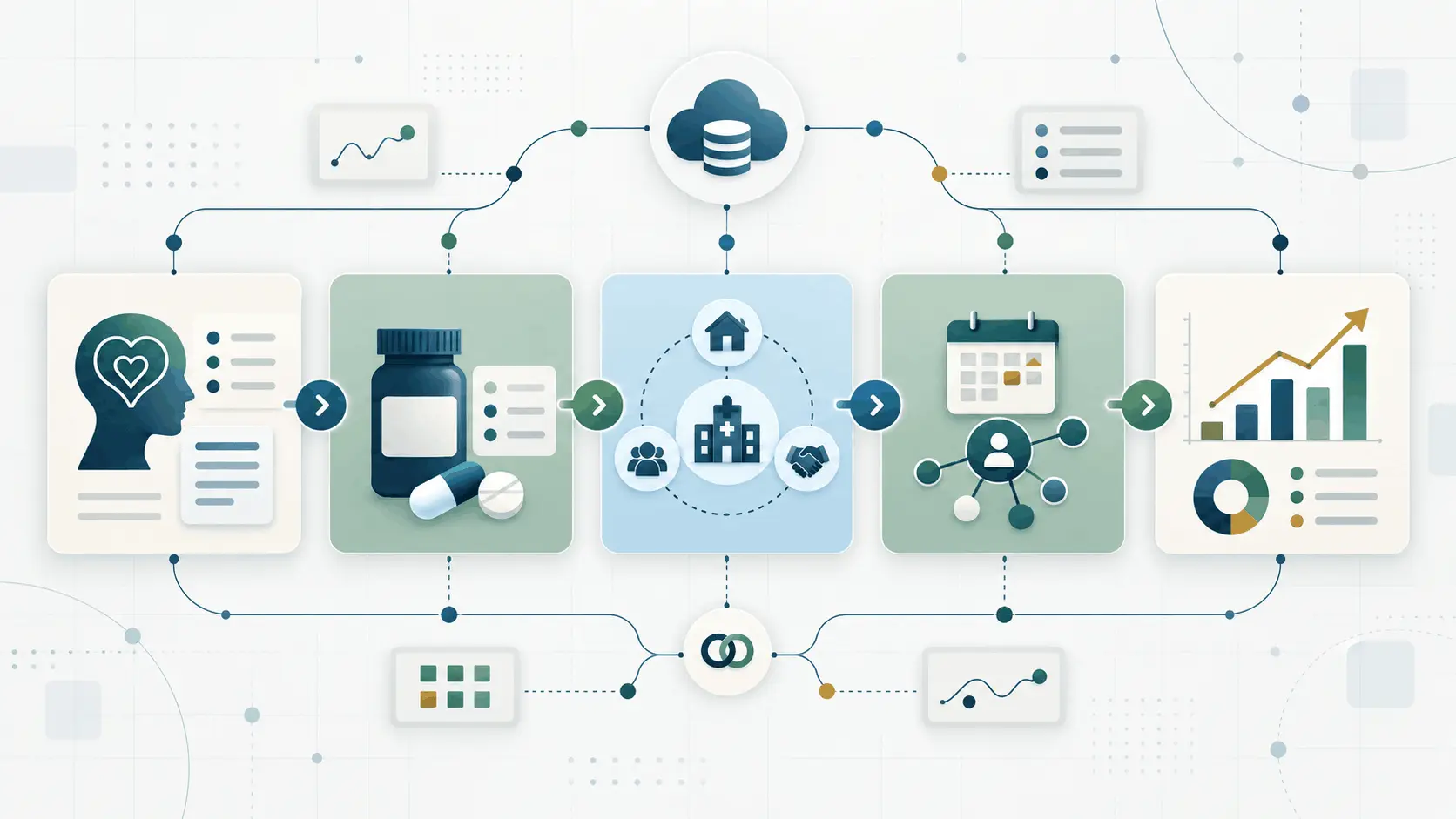
The handoffs between each team will likely generate new assessments, referrals, progress notes, and other critical documentation. Providers need technology that helps them connect these workflows so they can more easily communicate with one another. A dependable, shared view of the person’s care is critical to boost outcomes.
For CCBHCs, the technology stack should be evaluated by how well it connects information about processes. It should do more than just follow a compliance checklist—although it needs to do that as well—it needs to help providers deliver whole-person care.
From Application Inventory to Connected Care Architecture
A CCBHC requires a technology stack that works together to help providers remain compliant and provide quality care. Some of the features that are usually included are behavioral health documentation, case management, referral coordination, and client engagement.
However, it is critical that CCBHC software doesn’t treat these as isolated modules. Instead, there should be dependencies between them so they work together. Here are a few examples:
- A referral should connect to the identified need, treatment-plan goal, appointment status, and follow-up outcome.
- A medication should connect to the prescription, diagnosis, and history.
- An outcome should connect to the services and interventions that influence it.
The Shared Record: Clinical and CCBHC Case Management Data
A CCBHC’s shared record should function as an operational blueprint that helps clinicians, case managers, peer specialists, and program leaders operate. It guides them to assess a client’s needs, which interventions are underway, and whether those services are helping their progress.
To create this record, a technology stack needs to connect:
- Assessments, screenings, diagnoses, and presenting needs
- Treatment-plan goals and interventions
- Case-management activities, progress notes, and care-team assignments
- Crisis plans, safety planning, and social determinants of health (SDOH)
- Medication info, referral status, and information-sharing rules
Different roles will use the record for unique purposes, but the information should remain consistent across the board. For example, a clinician may focus on symptoms, a case manager may need housing visibility, and program leaders may need to monitor outcomes.
While free-text notes are helpful for clinical reasoning and context, structured fields are critical. Unstructured EHR data can be difficult to convert into measurable information. To test if a CCBHC technology will work for your organization, ask if the platform turns documentation into coordinated action.
A case manager should be able to see in one system if a referral was completed, a medication list was reconciled, or if a treatment plan goal requires review.
Medication Management as a Coordination Workflow
A CCBHC can integrate ePrescribing as a part of their scope for medication management and care coordination. While it can be a faster way to transmit prescriptions, it also gives the client's care team an up-to-date medication plan during intake, care transitions, follow-up visits, and treatment changes.
A typical medication management coordination workflow may include:
- Reconciling prescribed medications
- Identifying duplicate, inactive, or conflicting medications
- Managing refills, prior authorizations, and renewals
- Documenting medication-related decisions and care plan changes
In this workflow, it’s essential that clinicians, prescribers, and other authorized team members can understand the medication plan in the context of their behavioral health history, current services, risks, and treatment goals.
Documentation That Supports Compliance and Measurement
For CCBHCs, documentation must achieve multiple goals. It should help clinicians maintain continuity of care and give teams the information they need to coordinate services. In addition, it should provide the foundation for billing, contract reporting, quality improvement, and outcome analysis.
Without a built-in structure for their behavioral health platform, organizations can end up with documentation that doesn’t help them see the bigger picture. Notes can exist across an EHR, but it may not be structured in a way that helps leaders understand which:
- Clients have unmet clinical needs
- Referrals remain open
- Services connect to improvements
- Populations are suffering from engagement disparities
- Care-plan goals are being reviewed
These needs make structured documentation an operational necessity. A robust Community-Based Care Platform helps teams implement critical fields, service categories, timestamps, and referral types. Effective documentation helps CCBHCs discover what remains unsolved, who owns the next action, and if an intervention advances a client’s goals.
Improve Outcomes With a Traceable Data Model
With the right technology stack, outcomes can be defined in the same reporting as care delivery. To implement measurement-based care, develop an outcomes workflow that connects a client’s established need to a screening result, a treatment-plan goal, and the intervention provided. Be sure to identify the team member responsible for the action. They should know their next follow-up measurement and what a resulting change or status should look like.
As an example, follow this three-pronged structure to distinguish between critical measures for referrals:
- Activity: Number of referrals created.
- Process: Percentage of referrals that received documented follow-up
- Outcome: Change in functioning, symptoms, stability, or achieved goals
It’s important to measure these outcomes because a high volume of service delivery doesn’t always equate to effective care. For CCBHCs, a traceable data model helps connect daily service activities with quality improvement and outcome analysis.
How to Evaluate a Technology Stack for CCBHCs
CCBHC executives, clinical directors, and program managers must evaluate technology against real operating requirements. While a feature list can be helpful, you need to assess a layer deeper to understand if the platform can connect workflows across departments without creating additional administrative workflows.
Here is a list of questions to help you evaluate different software options:
- Does it reduce duplicate data entry across clinical and community workflows?
- Can staff trace a referral from identified need to completion?
- Can the system distinguish an open referral from a completed service?
- Can medication information be reconciled during care transitions?
- Are treatment-plan goals connected to interventions and outcomes?
- Can authorized users exchange information with relevant external partners?
- Does the data model support demographic, service-use, quality, and outcome reporting?
- Can managers revise workflows without custom development?
- Are audit trails, role-based access, and privacy controls built in?
- Can leaders analyze data without requiring manual spreadsheets?
CCBHC software needs to be interoperable because they often need to exchange technology with hospitals and community providers. During live software demos, ask vendors to show these four critical scenarios: a discharge transition, a medication-reconciliation event, an external referral, and a quality-reporting workflow.
Seeing specific scenarios in action helps your team understand if the platform supports end-to-end coordination.
The Benefits of a Community-Based Care Platform
PlanStreet’s Community-Based Care Platform has been tailored specifically for CCBHCs to connect the workflows that coordinate, document, and measure care. It’s a configurable environment for addressing every step of the case management process.
While below are some of the features, they all connect together to minimize administrative burden and increase data access for authorized users.
- Case Management: Track all elements of the process, from intake to monitoring and evaluation.
- Behavioral Health: Streamline administration with DSM-5 and ICD-10-ready therapy notes, form-building tools, and secure access to case notes from any device.
- ePrescribing: Review real-time medication safety and prescribe from within PlanStreet.
- Referral Management: Check the status at any time and improve client outcomes with automated reminders.
- Reporting: Easily visualize data in a few simple clicks, tracking everything from attendance to housing to outcomes.
WHEDco’s community-based non-profit utilized PlanStreet to centralize client records (including childcare records, family support case notes, and teen program attendance), automate reporting to track key performance indicators, and build custom workflows for intake, assessment, and service delivery.
The Strategic Value of Connected CCBHC Technology
CCBHC technology decisions influence how quickly teams identify unmet needs, how reliably referrals are completed, how safely medications are coordinated, and how confidently leaders evaluate outcomes. By connecting clinical and community-based workflows, CCBHCs can strengthen coordination while reducing the administrative burden created by fragmented systems.
See how PlanStreet's Community-Based Care Platform helps CCBHCs cut administrative overhead, connecting care management, referrals, documentation, and outcomes in one place.
CCBHC Tech Stack FAQs
It should connect behavioral health documentation, case management, treatment planning, medication workflows, referrals, care transitions, reporting, and outcome measurement. The objective is a consistent information flow across care processes rather than a collection of disconnected applications.
Closed-loop referral management tracks more than whether a referral was sent. It can help organizations monitor receipt, scheduling, appointment completion, barriers, follow-up, and updates to the client’s care plan.
Structured data supports cohort identification, population health management, quality reporting, disparity analysis, referral monitoring, and outcome measurement. It complements narrative documentation by making key information searchable and reportable.
They should evaluate interoperability, care coordination, medication reconciliation, referral tracking, treatment-plan management, configurable workflows, reporting, auditability, privacy controls, and the ability to connect services to outcomes.