The 2025 Budget Reconciliation Law overhauled the rules for eligibility for the previous Medicaid program. To enroll previously, adults only had to prove that they were low-income (with a few other exemptions). Now, there are updated qualifications, including a work requirement and new mandatory exemptions.
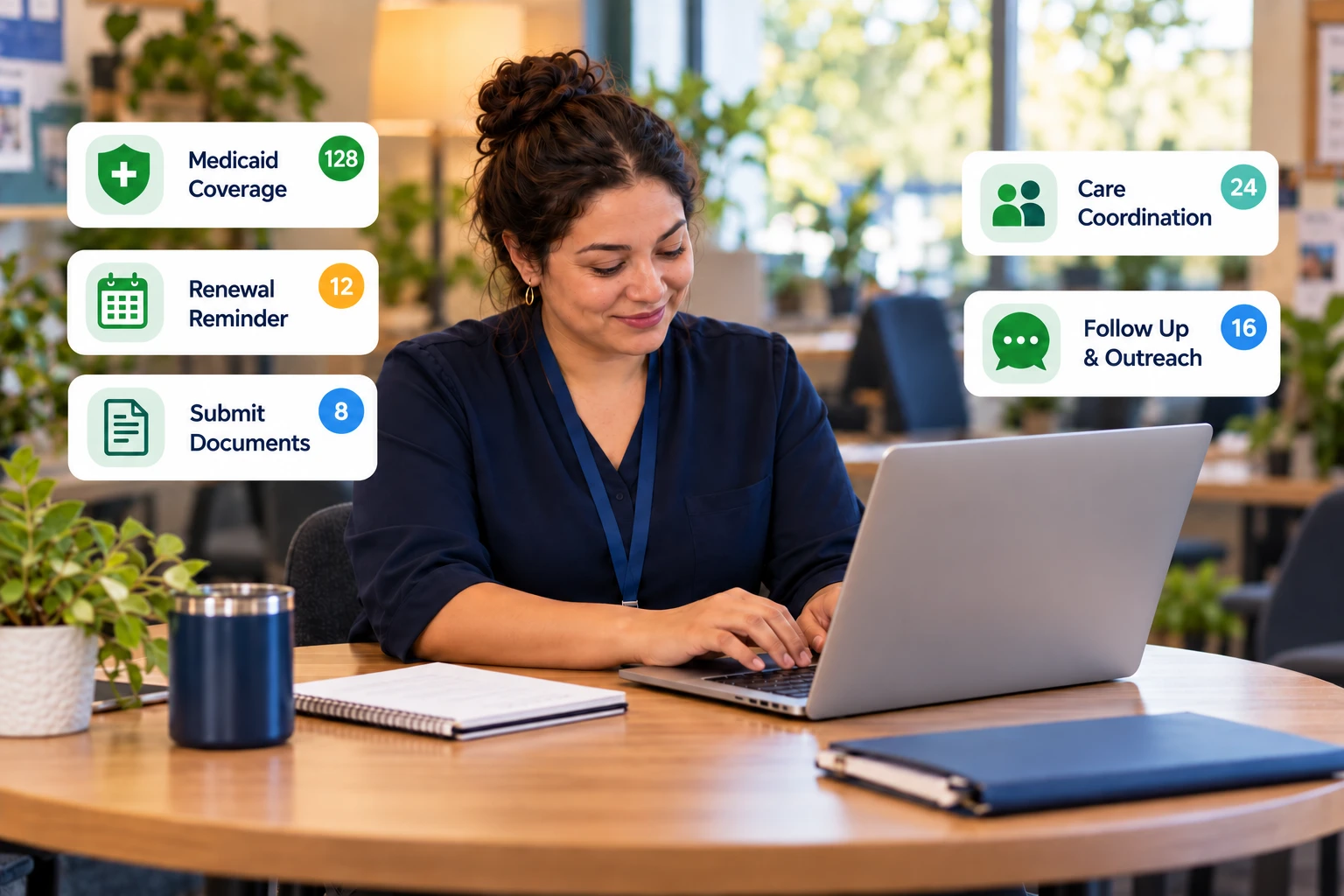
With these new policies, it is increasingly difficult for people experiencing homelessness to receive the healthcare they need to get and remain housed. Coverage interruptions can disrupt access to medication and routine care. When individuals are in and out of housing, it makes it harder to obtain important Medicaid mail or respond to time-sensitive renewal notices.
In light of these challenges, unhoused individuals often rely on homeless service providers to help them monitor Medicaid deadlines, update information, and gather documentation. While the requirements are more challenging, nonprofits can utilize technology to stay organized, track Medicaid eligibility, and help their clients maintain their coverage.
The Importance of Medicaid Coverage Continuity
For people experiencing homelessness, Medicaid coverage continuity helps them continuously access healthcare and supportive services that support progress toward housing. Medicaid may cover primary and behavioral health care, prescription medications, substance use treatment, and other services.
During the national Medicaid "unwinding" period, more than 25 million people were disenrolled, and 69% of disenrollments in states reporting reason data were attributed to paperwork or other procedural issues. That shows the importance of nonprofit and local service providers who help participants navigate the process.
When Medicaid coverage remains active, people are better positioned to:
- Continue taking prescribed medications and managing chronic conditions.
- Receive primary care, behavioral health care, and substance use treatment.
- Complete follow-up care after an emergency visit, hospitalization, or crisis event.
- Access Medicaid services and treatment available through their managed care plan.
- Avoid delays in care while a new application, renewal, or appeal is pending.
- Focus on housing, employment, benefits, and other self-identified goals.
For homeless services providers, supporting coverage continuity is part of whole-person care. By tracking renewal deadlines, keeping participant contact information current, documenting outreach, and connecting people with enrollment partners when needed, providers can help reduce gaps in care.
The Administrative Burden on Homeless Services Providers
Medicaid coverage continuity is no small task for organizations. For case managers and program teams, Medicaid continuity work can involve:
- Recording a participant's current Medicaid status, managed care plan, and known renewal date.
- Verifying preferred, safe, and consented contact methods as a participant's location or communication access changes.
- Reviewing renewal, verification, or termination notices, and identifying what action is needed before a deadline.
- Collecting and securely documenting supporting materials, such as notices, identity documents, income information, or other required verification.
- Assigning follow-up tasks so critical deadlines do not live only in one staff member's calendar, inbox, or memory.
- Coordinating with enrollment assisters, Medicaid managed care organizations, Health Care for the Homeless providers, legal aid, and other community partners.
- Documenting outreach attempts, participant responses, referral activity, and the next required action in a shared record.
- Escalating cases that involve a pending renewal, inability to reach the participant, missing documentation, possible termination, or an appeal deadline.
Homelessness services organizations have to do all this while continuing to deliver housing navigation, benefits assistance, crisis response, and ongoing case management.
That means they are often managing these responsibilities with limited capacity. In a National Alliance to End Homelessness survey of 5,044 homelessness-services workers, three out of four respondents said their organization was understaffed, and 71% reported that employee turnover was an issue at their workplace. Respondents also described frustration with duplicative database entry and burdensome reporting requirements.
When these details are dispersed across paper files, spreadsheets, email threads, separate program databases, and individual case notes, providers spend more time searching for information and reconciling records. That fragmentation also creates risk during staff turnover and cross-program handoffs, when another team member may not be able to see the participant's coverage status, prior outreach, or outstanding tasks.
5 Ways to Implement Technology to Stay Organized With Medicaid Renewal Tracking
A centralized, repeatable workflow gives teams a more practical way to manage this burden. Instead of responding only after coverage has lapsed, providers can identify approaching deadlines, coordinate accountability, document timely outreach, and connect participants with the right support.
Here are five key ways organizations can build their technology workflows to ensure a higher standard of care amidst more challenging Medicaid enrollment requirements.
1. Build Complete, Accessible Participant Records
Medicaid continuity depends on staff being able to find accurate participant information at the moment it is needed. When a renewal notice arrives, a case manager should be able to quickly confirm the participant's coverage status, locate an identification document, or determine whether outreach has already occurred.
A centralized participant record creates a shared source of truth for authorized staff. It gives relevant providers a clearer view of the participant's current situation, prior actions, and outstanding needs. This is especially critical when they move programs, change locations, or work with a new staff member.
The record should include:
- Medicaid coverage status, member ID when appropriate, the managed care plan, identification documents, income-related documents, and the renewal date.
- Preferred contact methods, including a safe phone number, email address, mailing address, shelter location, or trusted alternate contact.
- Case notes that document outreach attempts, participant responses, submitted paperwork, and the next required action.
- Care-team members, primary care or behavioral health providers, enrollment assisters, managed care contacts, and legal-aid partners.
- Referrals, appointments, and documented outcomes so staff can see whether a participant successfully connected with support.
Accurate contact information is particularly important. Verify contact information at every visit and document where a person is staying, how they can be reached, and whether there is a stable contact who may be able to help maintain communication.
Accessible records should also be governed by appropriate privacy, consent, and role-based access practices. Cross-sector information sharing should be relevant to care, limited to what is necessary, and supported by safeguards that give participants control over their information.
2. Organize Eligibility Workflows
A standardized workflow turns Medicaid-related tasks into clear, trackable actions instead of relying on staff memory or disconnected calendars. Organizations can configure stages such as:
- Coverage verified
- Renewal approaching
- Documents needed
- Outreach in progress
- Renewal submitted
- Pending decision
- Escalation needed
To help keep the process flowing, you can utilize technology automations. Consider assigning a staff owner and due date for every renewal task. Use reminders for approaching deadlines, missing documents, and follow-up appointments. A case management dashboard can help supervisors identify participants who need a follow-up quickly, without having to sort through emails or call logs.
3. Make Outreach and Follow-up Proactive
Effective outreach requires more than sending one reminder. Participants may change locations, lose phone access, miss mail, or need help understanding a notice and gathering documents. Teams need a consistent way to record each contact attempt and ensure no one falls through the cracks.
PlanStreet's Community-Based Care Platform supports and even automates proactive Medicaid outreach by helping staff:
- Use the participant's preferred and consented contact method for timely reminders about renewal dates, notices, or missing documents.
- Create and assign follow-up tasks after an unsuccessful call, message, or in-person contact.
- Set alerts for approaching deadlines, overdue follow-up, or repeated unsuccessful outreach attempts.
- Document whether the participant was reached, what support they need, and when the next contact should occur.
- Escalate unresolved cases to an enrollment assister, managed care contact, or another authorized support partner.
Centralized records and task reminders help make outreach a documented, team-based process rather than a one-time attempt.
4. Connect Coverage to Coordinated Care
Care coordination, transitional follow-up, and referrals to community and social supports are core services for people with complex needs. Use a homeless services case management platform to connect information across programs by:
- Centralizing participant records, service plans, case notes, and care-team contacts.
- Tracking referrals between housing providers, health care organizations, behavioral health providers, managed care partners, and other community resources.
- Documenting whether a referral was accepted, an appointment was scheduled, or follow-up is needed.
- Giving authorized teams a shared view of participant needs and next steps across services.
This coordination helps providers turn active coverage into meaningful connections to care and support.
5. Strengthen Data and Medicaid Reporting
Strong reporting helps organizations move beyond individual cases to identify where Medicaid continuity efforts need attention. An embedded platform like Microsoft Power BI in supportive housing software gives teams customizable dashboards, hundreds of visualization options, and the ability to generate and export tailored reports from a cloud-based database.
Organizations can use effective analytics reporting to monitor:
- Participants with upcoming renewal or recertification dates.
- Missing documents, incomplete contact information, or unresolved outreach.
- Outreach volume, successful contacts, and overdue follow-up tasks.
- Referrals to enrollment assisters, health care providers, behavioral health partners, or managed care organizations.
- Time spent on Medicaid-related case-management activities and program-level trends.
With accessible, configurable reports, leaders can identify bottlenecks, allocate staff resources, demonstrate program activity to funders, and improve processes before coverage risks become gaps in care.
PlanStreet in Action: Equal Hope
Equal Hope is a nonprofit organization that provides free breast and reproductive cancer screenings, navigation, and patient support. They serve uninsured and underinsured individuals, but also reach out directly to members of the Blue Cross Community Health PlansSM, which are partially funded by Medicaid.
They needed help with tracking data that was fragmented between teams, revising their manual case management process, and implementing a better reporting capability for funders and health partners.
When they implemented PlanStreet's Community-Based Platform, they were able to create a seamless client intake process, better coordinate care navigation, track program events, and implement data-driven reporting. This led to a:
- Notable increase in patient screenings and early cancer detection.
- Significant reduction in missed follow-ups and uncompleted referrals.
- Enhanced coordination between case managers, clinics, and outreach teams.
- Improved transparency for funders through real-time impact reporting.
- Greater accessibility of services to uninsured and underinsured individuals.
Help Staff Prepare for the Next Deadline With PlanStreet
Medicaid continuity is now harder to maintain, but organizing data using homeless services technology can help. Centralized records, trackable workflows, proactive outreach, coordinated referrals, and clear reporting keep teams ahead of deadlines and clients covered.
PlanStreet's Community-Based Care Platform gives homeless services providers one place to manage participant records, assign renewal tasks, automate outreach reminders, track referrals, and report on outcomes.
Instead of scrambling after coverage lapses, your team can see approaching deadlines, document every follow-up, and hand off cases confidently, even through staff turnover.
Ready to protect your clients' access to care? Schedule a demo today and see how PlanStreet helps your team keep more people covered.
Frequently Asked Questions
Create structured fields that separate the participant's known coverage status from the action needed: for example, renewal due, notice received, missing verification, unable to contact, application pending, appeal in progress, or coverage confirmed. This helps staff avoid treating every coverage interruption as an eligibility loss.
At minimum, the workflow should capture coverage status, managed-care plan, renewal or recertification date, preferred and permitted contact methods, renewal notices, required documents, outreach attempts, referral status, responsible staff member, and next action date. It should also include escalation rules for participants who have missing verification, receive a termination notice, or may need enrollment assistance.
Treat contact information as an active case-management field rather than a one-time intake data point. Staff should verify preferred contact methods at every meaningful interaction, document whether communication is safe and consented to, and prompt participants to update their information directly with their state Medicaid agency or plan when needed. A workflow should also record attempted contacts and outcomes, so teams can see whether a participant was reached, whether the contact information failed, and what follow-up is still needed.
Centralize Medicaid-related case information, tasks, notes, notices, documents, referral activity, and next steps in the participant record rather than relying on individual staff inboxes, spreadsheets, or informal knowledge. Configure ownership fields, due dates, reminders, and handoff processes so another authorized staff member can quickly see what action is pending and what has already occurred.