Under Healthy People 2030, the US government has outlined five areas to focus on social determinants of health (SDOH), which include economic stability, education access and quality, health care access and quality, neighborhood and built environment, and social and community context. A completed social-needs screening is an important first step to address these issues, but the work only begins there.
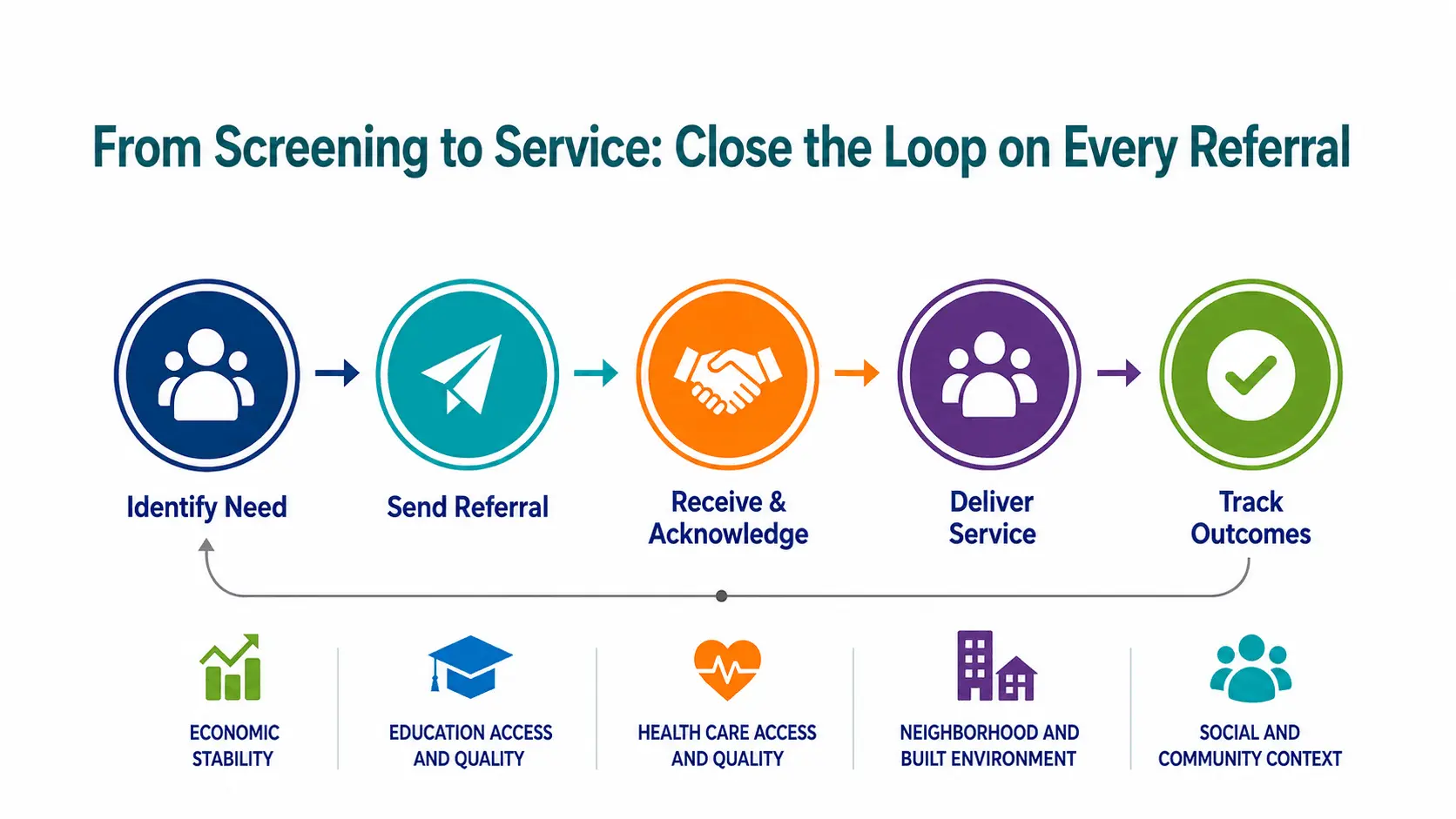
When a person screens positive for food insecurity, housing instability, or transportation barriers, care teams need a reliable way to move forward. That could be to assign follow-up, connect the person to an appropriate resource, track whether the receiving organization accepted the referral, and document the outcome.
SDOH workflows often fail after screening because data, referrals, and outcomes are tracked within different systems at different agencies. That makes it harder to coordinate care, demonstrate timely intervention, measure program impact, and prepare quality-reporting data.
That's why so many agencies are turning to SDOH closed-loop referral management, which turns every referral into a traceable workflow, boosting outcomes.
The CMS 2026 SDOH Reporting Mandate Landscape
The CMS (Centers for Medicare & Medicaid Services) 2026 reporting mandate has changed for some organizations. For example, while there initially was a plan for REHQR SDOH mandatory reporting in 2024, CMS finalized the removal of the outpatient SDOH screening and screen-positive-rate measures beginning with the CY 2025 reporting period.
Therefore, organizations should confirm requirements for their own setting, payer contracts, state Medicaid programs, and accreditation/reporting obligations rather than assume one universal 2026 mandate.
The strategic need for structured SDOH data and documented action continues even where a particular CMS reporting measure has been removed. In CMS's Accountable Health Communities model, more than 1.1 million people were screened for health-related social needs by June 2022, and more than 35% reported at least one need that made them eligible for referral to community services.
What NCQA SNS-E Measures and the Critical Intervention Step
The NCQA's (National Committee for Quality Assurance) Social Need Screening and Intervention—Electronic (SNS-E) measure is a HEDIS measure that evaluates two things. First, whether people were screened or assessed for unmet food, housing, and transportation needs during the measurement period. And second, whether people with a positive screen or identified need received a corresponding intervention within 30 days.
The screening result does not demonstrate intervention by itself. To support SNS-E performance, organizations must be able to connect the identified need with timely, corresponding follow-up.
For example, if a client screens positive for transportation insecurity, a generic note that "resources were discussed" may not be enough for an operationally defensible workflow. The organization should be able to show:
- The identified need
- The selected transportation-related intervention
- The referral or service action
- The date
- The responsible staff member
- Any available result or outcome
Why SDOH Screening Alone Creates a Documentation Gap
While SDOH screenings are an incredibly helpful tool, they are only the first step. They often result in a lost referral. In large health systems, only 34.8% of referral scheduling attempts result in a completed appointment. While this can be due to issues such as long wait times to see a specialist and travel distances to specialists, if no provider follows up, then these problems can't be solved.
A lost referral usually looks like this:
- The referral disappears after it is sent. A staff member may provide a resource list or make a referral, but no system confirms receipt or scheduling of service.
- The need and intervention are separated. Screening data may remain in an EHR or intake form, while referrals appear in email, spreadsheets, or paper notes.
- Follow-up ownership is unclear. No assigned staff member, due date, alert, or escalation path means time-sensitive interventions may stall.
- Outcome data is incomplete. Leaders cannot distinguish a referral sent from a referral accepted, an appointment booked, a service delivered, or a client's need resolved.
- Reporting is manual and unreliable. Quality and compliance teams must assemble evidence retrospectively from fragmented records.
Care coordinators can help solve this issue by implementing a closed-loop referral system that covers SDOH.
What Is a Closed-Loop Referral for SDOH?
A closed-loop SDOH referral is a coordinated, documented process that tracks a social determinants of health referral from identification of a need through referral transmission, receiving-organization acknowledgment, follow-up, service outcome, and closure.
It's a six-step process that looks like this in practice:
- Identify the need: Capture structured results for food, housing, transportation, or other social needs.
- Select an intervention: Match the need to the appropriate service, benefit, or program.
- Send and document the referral: Link the referral directly to the client record.
- Confirm receipt and engagement: Record whether the partner received, accepted, declined, scheduled, or could not fulfill the referral.
- Document outcomes: Capture appointment status, service delivery, client contact, barriers, outcome notes, and next steps.
- Close the loop: Mark the referral complete, unresolved, declined, or closed for another documented reason; retain the timestamped history for reporting and review.
By using a closed-loop referral system in a SDOH reporting software for healthcare, hospital administrators and CBO program directors can go above and beyond the requirements set by the CMS and NCQA.
What Makes an SDOH Referral Trail Audit-Ready?
Imagine the SDOH screening and referral process for a Medicaid MCO quality team. They may need to review whether a member who screened positive for housing instability received a documented, housing-related intervention within the required timeframe for HEDIS SNS-E reporting.
An audit-ready referral trail lets the team quickly connect the positive screen to the referral sent, the receiving organization's response, follow-up activity, and the documented outcome. They can't rely on disconnected notes or an unverified claim that a referral was made, which risks their social determinants of health compliance.
To ensure that your SDOH referral trail is audit-ready, it needs to contain the following elements:
- A structured screening result tied to the client record.
- The specific need domain and positive result or identified need.
- A corresponding intervention.
- Referral destination, assigned staff member, date sent, and due date.
- Status changes, such as sent, received, accepted, scheduled, completed, declined, or unable to contact.
- Secure notes and communications that preserve care-coordination context.
- Documented outreach attempts and escalation steps for unresolved referrals.
- Outcome documentation, including whether service was accessed and whether further support is needed.
- Reporting fields that allow organizations to monitor timeliness, completion, bottlenecks, and outcomes by program, location, need type, or referral partner.
Audit-ready means the organization has documented workflows, consistent data capture, user accountability, and accessible records that can support internal review and applicable reporting requirements.
How PlanStreet Supports Closed-Loop SDOH Referral Workflows
Closing the loop on a social-needs referral requires the screening result, the referral action, and the outcome to live in one connected record. PlanStreet's Community-Based Care Platform is built around that connection, giving teams what they need to support SNS-E performance at every step:
- Connected screening and case records: A positive screen for food, housing, or transportation needs feeds directly into the client's case record.
- In-platform referrals: Staff can send a referral to a third-party provider or CBO without leaving PlanStreet, and that referral stays attached to the client's file.
- Real referral status tracking: Teams can follow a referral's actual status, whether it was sent, received, accepted, scheduled, completed, or declined.
- Automated ownership and follow-up: Automated tasks and alerts assign clear responsibility for next steps, so referrals don't stall.
- Outcome documentation: Staff can log whether a client kept the appointment, accessed the service, hit a barrier, or needs further support.
- Configurable workflows: Forms, referral steps, and processes can be adapted to match each organization's own programs.
- On-demand reporting: Monitor referral timeliness, completion rates, and outcomes across programs, locations, and referral partners.
Together, these capabilities keep the need, the intervention, the referral status, and the outcome timestamped and stored in one place. This is exactly the kind of evidence teams need to demonstrate a corresponding intervention within SNS-E's 30-day window, without relying on manual chart review after the fact.
Boost Care and Compliance With PlanStreet's Closed-Loop Referral Platform
Screening identifies a need. Closing the loop proves it was addressed. As SDOH reporting expectations continue to evolve across CMS, NCQA, and state Medicaid programs, referral workflows need to hold up to scrutiny.
PlanStreet connects screening, referrals, and outcomes in one system, so your team's everyday workflow builds the audit-ready trail. There's no need to reconstruct records under deadline pressure. Schedule a call with PlanStreet today to see how closed-loop referral management can strengthen your SDOH screenings.
Frequently Asked Questions
A closed-loop referral is a referral process that documents and tracks the full handoff from an identified need to referral delivery, receiving-provider acknowledgment, follow-up, service outcome, and closure. In an SDOH workflow, it helps teams show whether a person's food, housing, transportation, or other social need was connected to a corresponding intervention.
NCQA's Social Need Screening and Intervention—Electronic measure, or SNS-E, assesses whether people were screened or assessed for unmet food, housing, and transportation needs and whether people with a positive screen or identified need received a corresponding intervention within 30 days.
No. A positive screening result identifies a need; it does not itself document that the person received an intervention. Organizations need a workflow that connects the identified need to a matching service, referral, resource-navigation activity, benefit-support action, or other documented intervention.
Useful documentation includes the positive screen or identified need, need domain, intervention selected, referral destination, date sent, staff owner, referral status, follow-up activity, receiving-organization response, service outcome, and closure reason. Organizations should use current NCQA specifications and applicable payer or program requirements to determine exactly what qualifies for their reporting.
Case-management software can centralize screening results, connect them to case plans and referrals, assign follow-up work, track referral status, document service outcomes, preserve communications, and generate program-level reports. These capabilities reduce reliance on disconnected spreadsheets, inboxes, and manual chart review.