Key Takeaways:
- Keeping humans in charge means AI can speed up admin work like drafting notes and summarizing cases, but staff must always make the final call on client decisions.
- Trust is built through transparency and privacy, protecting client data with role-based access while staying upfront with staff and clients about when and how AI is used.
- Adoption should start small and scale gradually, piloting AI on low-risk tasks, measuring results, and expanding only once staff feel comfortable and trust is established.
Due to changing budgets, human services organizations have found themselves having to do more with less. For example, the HHS (Health and Human Services) reduced its team by about 25% last year. But even when the workforce is reduced at a social services agency, the number of clients they are expected to care for does not always decrease.
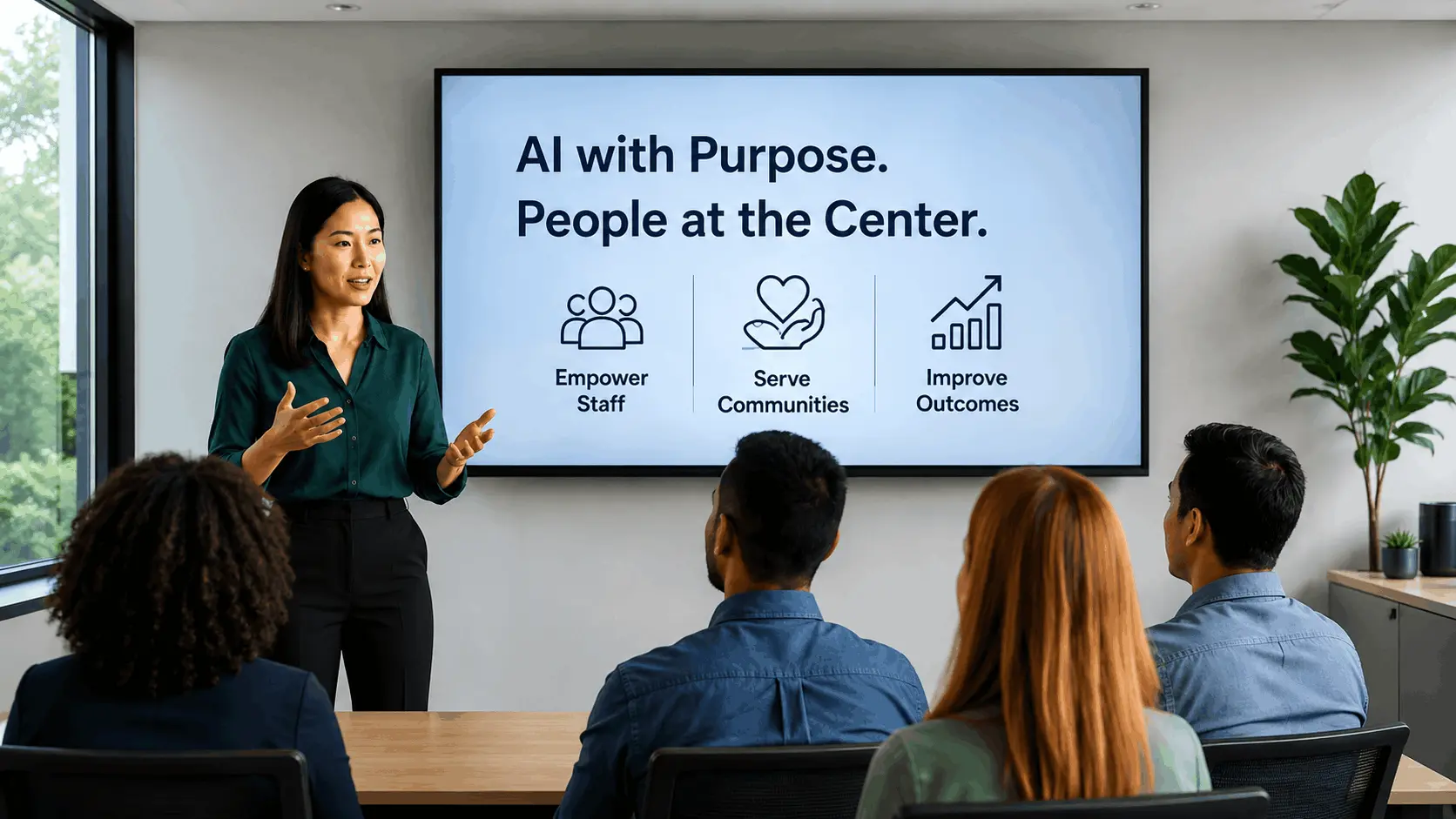
There is a strong potential for AI to help caseworkers, social workers, and other frontline staff pick up the slack. This can include administrative work, documentation, and information-finding.
However, there are valid fears about using AI, with shocking statistics about improper usage: reports of malicious actors using AI to spam victims have risen 8-fold since 2022. Your team may be concerned about client privacy, inaccurate outputs, and unclear decision-making. And they have a right to be.
But the good news is that responsible AI use in human services prioritizes human decision-making. It's about creating faster workflows while keeping people, professional judgement, and organizational values at the center, while streamlining manual tasks that can get in the way of that. Today, we'll show you how to slowly implement AI in organizations in a way where people can trust the way they're using it.
The Importance of AI Trust in Human Services
AI use in human services legally requires additional levels of trust. Because human services teams work with sensitive information, including health details and housing status, they must follow security standards aligned with HIPAA.
Even more, staff need to feel confident that executives are not trying to replace them with an AI tool. There must be trusted AI frameworks in place, including data integrity, fairness, interpretability, compliance, and human-AI collaboration.
To start, trust is built when organizations can answer these five questions:
- What is the AI doing?
- What data does it use?
- Who reviews its output?
- How are risks monitored?
- What happens when it gets something wrong?
The Core Principles of Responsible AI Adoption
To utilize human services AI properly in your organization, we recommend implementing the following five core principles.
1. Keep Human Judgement in Control
No matter what, your staff has to be the ones who are making the final decision. Anything related to care, services, treatment, documentation approval, and client interactions must come from a human.
If you're using AI, you can use it for things like:
- Drafting case notes
- Organizing case information
- Summarizing an important meeting
- Flagging missing information
- Breaking down complex administrative requirements
While AI can help your team work faster, it cannot replace professional expertise, cultural understanding, and contextual nuance that only humans understand. Miles AI can draft case notes and summarize documentation, helping your team make decisions faster.
2. Protect Client Privacy and Data
Your client's data must be protected, first and foremost. Just like with any case management software, you need to create clear rules around authorized access, permitted use cases, and role-based permissions.
For example, if a vendor only has access to certain cases pertinent to their work, then they should only be able to utilize AI with that case data. You should be able to track where data has been used and who can access it. Human services AI like Miles can create reports for you to understand exactly where data has been implemented and viewed.
3. Make AI Use Transparent
One of the most important trust-building elements of AI use is simply saying when it's been utilized. Make sure your team knows which contexts are appropriate for AI or not. That can be communicated through plain-language policies that should be easily accessible from within case management software.
Ensure that staff has a clear workflow to:
- Question any information that the AI gives them
- Correct errors that the AI may have generated
- Report concerns about AI use to the right supervisor
4. Identify and Address Bias
AI can sometimes struggle to understand the difference between knowledge and belief. Hallucinatory rates among AI models range from 22% to 94%. Even with an AI created for human services, it's important to recognize that human review of AI work is essential.
AI often reflects gaps or inequalities present in data, processes, and historical practices. Always review the outputs for unequal patterns across:
- Populations
- Languages
- Geography
- Disability status
- Race and ethnicity
- Gender
- Socioeconomic circumstances
5. Start With Reliable, High-Quality Data
When utilizing an AI model, always start with the highest quality data possible. This is easy to do when using a human services AI like Miles, because it's connected directly to your case management software. However, if you use an outdated spreadsheet or case note, that means that the report or answer the AI gives you will be inaccurate.
How to Start Using AI Effectively and Safely
With a base understanding of core practices, now it's time to think about how to curate responsible AI adoption at your CBO, nonprofit, or government agency.
1. Create Clear AI Governance
AI governance in nonprofits includes the policies, roles, review process, and safeguards that determine how an organization selects, uses, monitors, and improves AI tools. Create a trusted group of individuals from across the organization, including executive leaders, IT, frontline users, and compliance officials, to outline these policies.
The governance should include:
- Approved and prohibited AI use cases: Clearly define which AI applications are permitted and which are not.
- Privacy, security, and vendor-review requirements: Establish standards for protecting client information, controlling access to data, and evaluating AI vendors.
- Human-review requirements for AI-generated content: Require qualified staff to review, verify, edit, and approve AI-generated summaries and documentation.
- Bias and accuracy evaluation procedures: Create a process for testing AI outputs for errors, inconsistencies, and potentially unfair patterns.
- Incident-reporting and escalation processes: Give staff a clear way to report concerns and other AI-related issues, along with defined steps for resolving them.
- Documentation of training, decisions, and ongoing monitoring: Keep records of any changes made to policies or workflows over time.
2. Prepare and Empower Staff
Address staff directly about AI use, and be prepared for their concerns. In social services, AI-based decision tools have faced much backlash. Assure your employees that you don't want to take away their decision-making skills, only to help them work more efficiently.
Start with role-based training that shows your staff how to use the tool, so they can see firsthand how it will help improve their workday. Stress this: that while AI can make work easier, it doesn't remove professional responsibility. Leadership should gather feedback from staff during implementation to catch workflow issues early and discover unexpected risks.
3. Begin With Low-Risk, High-Value Workflows
Don't use AI for high-stakes decisions; instead, utilize it for administrative and documentation-heavy tasks. For example, AI can be excellent at:
- Converting dictated notes into structured text
- Summarizing a case history for staff review
- Extracting information from intake documents
- Identifying incomplete claim information before submission
PlanStreet's Miles AI has the capability to complete these types of tasks across intake, documentation, case review, payments, billing, and reporting, helping teams reduce manual effort while retaining staff control.
4. Pilot, Measure, Improve, Expand
The important part of implementing new software is to move slowly. Follow the steps below:
- Pilot: Start with one defined use case and a small group of users (for example, using AI to reformat dictated case notes).
- Measure: Establish what success looks like (for example, minutes saved completing case notes).
- Improve: Review processes for accuracy, workflow impact, and equity concerns, and make changes as needed. Ask staff for additional input.
- Expand: Only after staff feel comfortable, gradually expand the AI uses.
Gradual adoption like this creates space to learn, improve safeguards, and earn organizational confidence.
Miles AI: Strengthen Human Services, Never Replace Them
To implement ethical AI for nonprofits, trust is the prerequisite. That's why our team at PlanStreet created Miles AI. Accessible within PlanStreet, a Community-Based Care Platform trusted by human services organizations across the United States, Miles AI is built to support people doing the work. It helps teams spend less time on administrative burden and more time delivering person-centered care.
Explore how Miles AI could help improve processes at your nonprofit and schedule a free demo with our team today.
Frequently Asked Questions
Yes. PlanStreet's platform, including Miles AI, is built on infrastructure that is HIPAA compliant, with role-based access controls, encryption, and audit trails built in. For agencies with federal funding requirements, our platform is also FedRAMP-ready and meets NIST 800-53 standards.
It depends on how AI is used and your state's requirements. Internal use, like AI helping staff draft or organize notes, generally requires disclosure rather than formal consent. AI that directly interacts with clients or shapes service decisions typically calls for a higher bar. When in doubt, disclose.
Be specific and upfront. Update intake paperwork or client rights materials to name the tool, explain what it does, and confirm a human always reviews and approves anything it produces. Clear, written disclosure builds trust and protects your agency.
Accuracy isn't a one-time check. We recommend agencies build audits into their ongoing routine: define what "good" looks like, spot-check AI outputs regularly, watch for uneven results across populations, and name a specific person accountable for reviewing performance.