Key Takeaways:
- Good HMIS sharing means giving each CoC and agency partner only the access they need, backed by clear policies and data quality standards.
- Strong governance relies on written agreements, consent practices, and interoperable workflows across agencies.
- Platforms like PlanStreet can help turn these governance principles into consistent, repeatable workflows.
Homeless-response systems are built by many entities working together to house people quickly, while providing the services they need to keep them housed. This includes shelters, outreach teams, housing services, behavioral health providers, and more, all coordinating together.
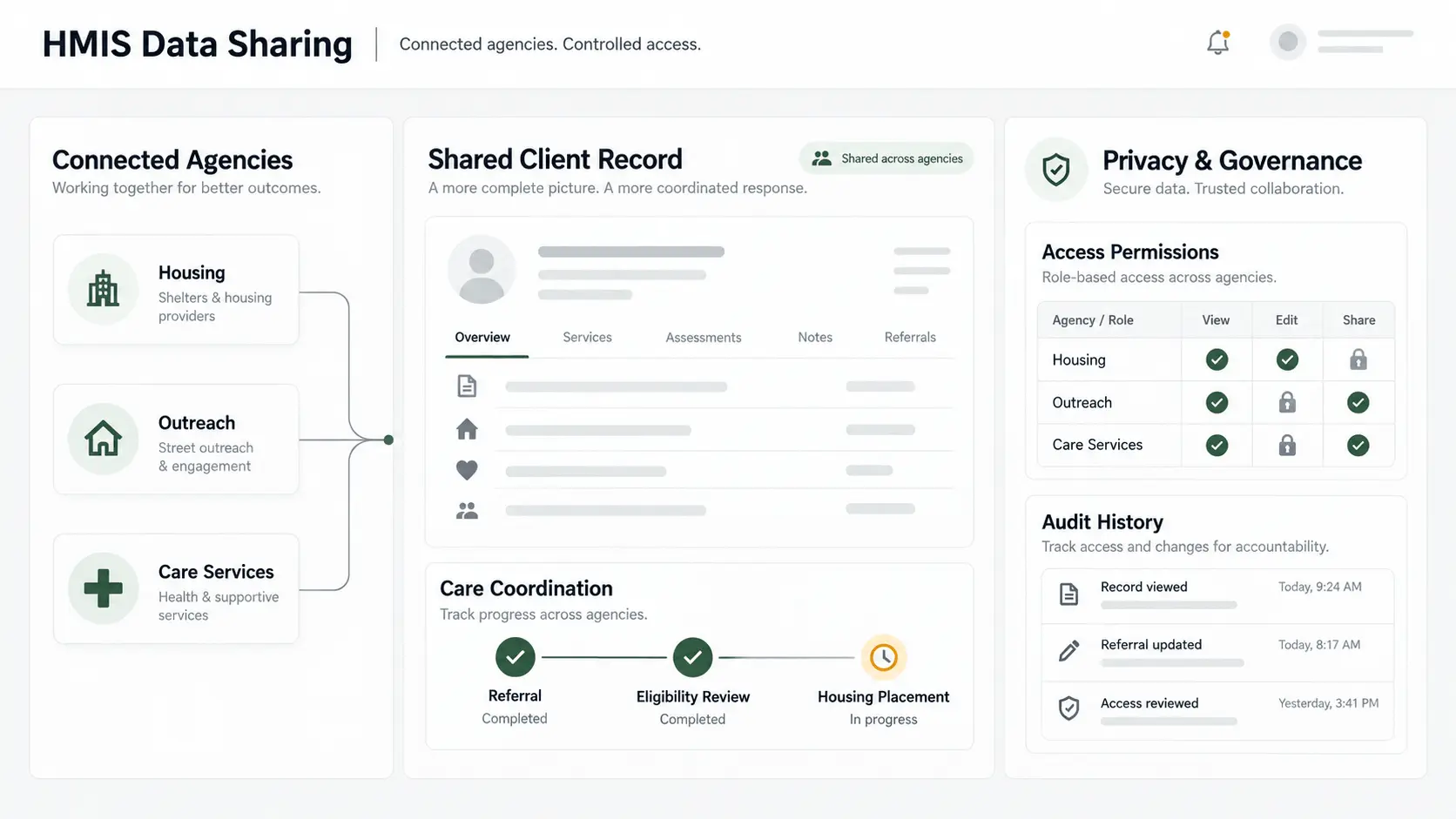
A client's housing pathway can stall when agencies don't have a full picture of where they are in the process. For example, an outreach provider may refer a client to a rapid rehousing program after a coordinated-entry assessment. However, the referral can sit unresolved if the housing provider cannot see whether the client completed eligibility screening.
With a 12% increase in homeless response services from 2023 to 2024, the rising demand for homeless services points to the need for better communication systems, so providers can increase service delivery. However, indiscriminate access creates privacy risk, weakens client trust, creates unclear accountability, and exposes CoCs (Continuums of Care) to inconsistent HMIS data-sharing practices.
Instead, CoCs need a well-governed HMIS (Homelessness Management Information System) that supports minimum necessary visibility, meaningful coordination, reliable data, and documented accountability.
HMIS Data Sharing Is a Technical and Operational Issue
Cross-agency coordination puts clients' sensitive information on the line. They trust you to share their data appropriately to ensure their data is protected. And that goes beyond just a security issue. Just because someone is cleared to see someone's information doesn't mean they have to.
CoCs should jointly manage policies and procedures that provide a baseline for monitoring data and sharing information amongst the proper parties. For example, the HUD Lead Improvement Evaluation Matrix offers a four-step system to improve joint workflows:
- Plan: What changes are needed and who is responsible?
- Do: What is being done differently since our last monitoring process?
- Study: What do the results of our HMIS lead monitoring process tell us?
- Act: How do we improve the performance of our HMIS based on our monitoring process?
The Four Decisions Behind Responsible HMIS Data Sharing
For a more general scope of data sharing, we will discuss the following four components:
- Purpose: What care, housing, or system-management decision does this data support?
- Permissions: Which agency, program, role, or user should see and/or edit it?
- Data quality: Is the information sufficiently accurate, complete, or timely to be acted on?
- Accountability: Who reviews access, monitors use, resolves discrepancies, and updates policies?
1. Define the Purpose Before Expanding Access
Make access decisions based on a specific workflow, not on a general interest in client data. For example, think about how these three important parts of a CoC may need the same data for different uses:
- Coordinated-entry team: Assessment, prioritization, referral, and housing-placement status.
- Housing provider: Eligibility documentation, referral details, and enrollment milestones.
- System administrator: Data-quality and audit information, but not full case-note access.
Defining the clear purpose for each of these groups ensures that permissions remain limited to the needs of each person. It also helps save time so that each person only receives the records they need and is not overwhelmed combing through paperwork.
2. Translate Privacy Policy Into Practical Permission Design
An HMIS privacy policy directly shapes system configuration. Translate approved policies into role-based rules for agency access, program visibility, and data-sharing settings. This way, users can act on the information without unrestricted access to client records.
According to HUD's HMIS privacy guidance, a CoC's privacy notice must describe permitted uses and disclosures of participant information, including information used to provide or coordinate services. The privacy policy is a practical input for configuring who can access, use, and share client information in the HMIS.
3. Build Consent and Notice Into the Service Experience
Clear privacy choices help clients understand how their information may be collected, used, and disclosed. Under HUD's data protection policies, they need to be told what choices they have and how the organization will respond if concerns arise.
A client-centered approach for HMIS data governance includes:
- Explaining data-sharing practices in plain language at intake and at any relevant changes.
- Documenting consent or releases of information when required by local privacy policies, applicable laws, or program requirements.
- Giving staff practical guidance for answering client questions about information access.
- Maintaining a clear grievance process when participants believe their information was handled inappropriately.
4. Treat Data Quality as a Prerequisite for Sharing
While a connected HMIS workflow can be valuable for all stakeholders working on a client's case, it's only beneficial if the data quality is high. A stale referral status can trigger duplicate outreach, inconsistent project setup can affect coordinated-entry decisions, and missing enrollment can weaken system-level analysis.
Agencies can ensure they hold data standards by sharing definitions, workflows, and accountability for data entry. While prepping to expand HMIS data entry, CoCs should establish standards for:
- Completeness: Required client, enrollment, referral, and exit fields are populated.
- Timeliness: Staff enter updates soon enough for partners to act on them.
- Accuracy: Information reflects the client's current circumstances and service activity.
- Consistency: Agencies interpret and enter the same data elements the same way.
How to Build a Governance Model for Cross-Agency Collaboration
Effective HMIS data sharing requires a governance model that turns shared expectations into repeatable decisions. A governance charter establishes who owns the decisions that shape how the HMIS operates across the community, from data visibility to user access and quality oversight.
A sample cross-agency model typically includes the following elements for coordinated data entry, but this should only be a starting point. Any agency should add on or customize as needed to establish a stronger system.
- Decision rights: Define who can approve data-sharing rules, grant exceptions, change program visibility, and resolve disputes between agencies.
- Written agreements: Use governance charters alongside participation, user, and data-sharing agreements to document roles and responsibilities.
- Standard operating procedures: Establish consistent processes for onboarding, training, access, incidents, data-quality, and policy updates.
- Monitoring cadence: Routinely review access, sharing configurations, data-quality trends, and partner adherence.
- Change management: Revisit governance decisions when changes occur, including program expansion, new partner participation, or the evolution of privacy requirements.
Establish a governance committee from amongst participating members. This can include your CoC leadership, the HMIS system administrator, provider representatives, and legal input as needed.
How HMIS Interoperability Can Support Controlled Collaboration
HMIS interoperability helps authorized users access or exchange the information needed to move a client's housing or service workflow forward. But interoperability requires alignment across workflows, data structures, and governance.
A mature approach includes three levels of interoperability:
- Workflow interoperability: Participating agencies can coordinate referrals, follow-up tasks, status updates, and next steps across programs.
- Data interoperability: Shared definitions, data mappings, and client-record structures help ensure information is understood consistently across participating programs.
- Governance interoperability: Agencies follow shared rules for data use, access, consent, quality, oversight, and accountability.
Aligning these three approaches ensures that each provider has the next steps they need while preserving appropriate boundaries around sensitive client information.
An Example of a Controlled Data-Sharing Workflow
A controlled workflow gives the right participant information to the correct authorized user when they need it in the housing process. Each handoff is governed by the CoC's privacy notice, consent procedures where applicable, role-based permissions, and data-quality expectations.
To see this in action, let's review what a coordinated-entry referral to a rapid-rehousing program could look like in a platform like PlanStreet:
- An access point completes the coordinated-entry assessment and records the eligibility and prioritization information needed for housing matching.
- The coordinated-entry team views the information needed to make a referral and monitors whether it is pending, accepted, declined, or needs follow-up.
- The rapid-rehousing provider receives the approved referral and only the information necessary to begin eligibility review and client outreach.
- The provider records the referral outcome and, when applicable, the enrollment status, allowing the coordinated-entry team to see progress without exposing unrelated case notes, documents, or historical information.
- The HMIS administrator monitors incomplete required fields, overdue referral responses, and access activity under the CoC's established data-quality and security procedures.
How PlanStreet Supports Governed HMIS Collaboration
PlanStreet's Community-Based Care Platform can serve as the operational layer that helps homeless-service networks turn local privacy, data-sharing, and governance policies into controlled, repeatable workflows. PlanStreet allows CoCs to give authorized users the visibility and tools needed to complete the next appropriate action while safeguarding sensitive client information.
PlanStreet supports that model through:
- Role-based access controls: Configure permissions around user roles and responsibilities so access can align with approved agency, program, and visibility requirements.
- Coordinated client information: Keep relevant client, program, service, referral, and case-management activity connected while allowing organizations to define who can view or update specific information.
- Configurable workflows: Standardize intake, assessments, referrals, service delivery, follow-up, and exception handling across programs and participating partners.
- Data validation and reporting: Use configurable forms, conditional logic, validation features, reporting, and analytics to support data-quality oversight.
- Structured, auditable operations: Create more consistent processes for documenting activity, monitoring workflows, and maintaining accountability across the service network.
Improved HMIS Data Sharing Workflows in Action: Living Grace Homes
Living Grace Homes provides safe housing and supportive services for pregnant women and young mothers experiencing homelessness or housing instability. They needed an HMIS solution that would eliminate duplicate data entry, improve coordination across housing and family support programs, provide staff with a complete view of each client's services, and simplify day-to-day case management.
They turned to PlanStreet, which helped them:
- Eliminate duplicate data entry through automated HMIS integration
- Accelerate client onboarding into housing and supportive services
- Centralize housing and family support case management
- Improve coordination across multiple housing programs
- Track services, referrals, and client progress in one platform
- Increase operational efficiency and spend more time with clients by reducing administrative work
- Improve visibility into program performance and client outcomes
Improve Data Sharing Across Agencies With PlanStreet
PlanStreet helps CoCs, housing agencies, and homeless-service providers build a more connected service network without treating privacy and governance as an afterthought.
Ready to streamline your HMIS workflows and better collaborate with stakeholders? Schedule a free demo with our team today.
Frequently Asked Questions about HMIS Data Sharing
HMIS data sharing is the controlled use or exchange of client, program, service, referral, and outcome information among authorized organizations and users in a homeless-response system. Effective sharing depends on clear purpose, role-based permissions, privacy policies, and data-quality standards.
CoCs can use written privacy policies, participant notices, purpose-based access rules, role-based permissions, staff training, access reviews, and documented data-sharing procedures. HUD guidance highlights the importance of aligning local data-sharing functionality with approved privacy policies and user access rights.
A strong plan addresses decision-making authority, privacy and security rules, data-quality expectations, user access, training, monitoring, agreements, incident response, and policy review. HUD identifies privacy, security, and data-quality plans as core elements of CoC HMIS responsibilities.
Interoperability only improves decisions when shared data is complete, timely, accurate, and consistent. Without common definitions and quality controls, agencies may act on outdated, incomplete, or conflicting information.