Choosing the right HMIS (Homeless Management Information System) is critical, particularly with evolving needs and compliance rules. Nearly half of California CoCs (Continuums of Care) changed their HMIS software provider over a six-year period.
With a stronger need for reporting accuracy and compliance, agencies and nonprofits require a solution that can adapt and grow to meet more government requirements.
That's why validation from government offices matters.
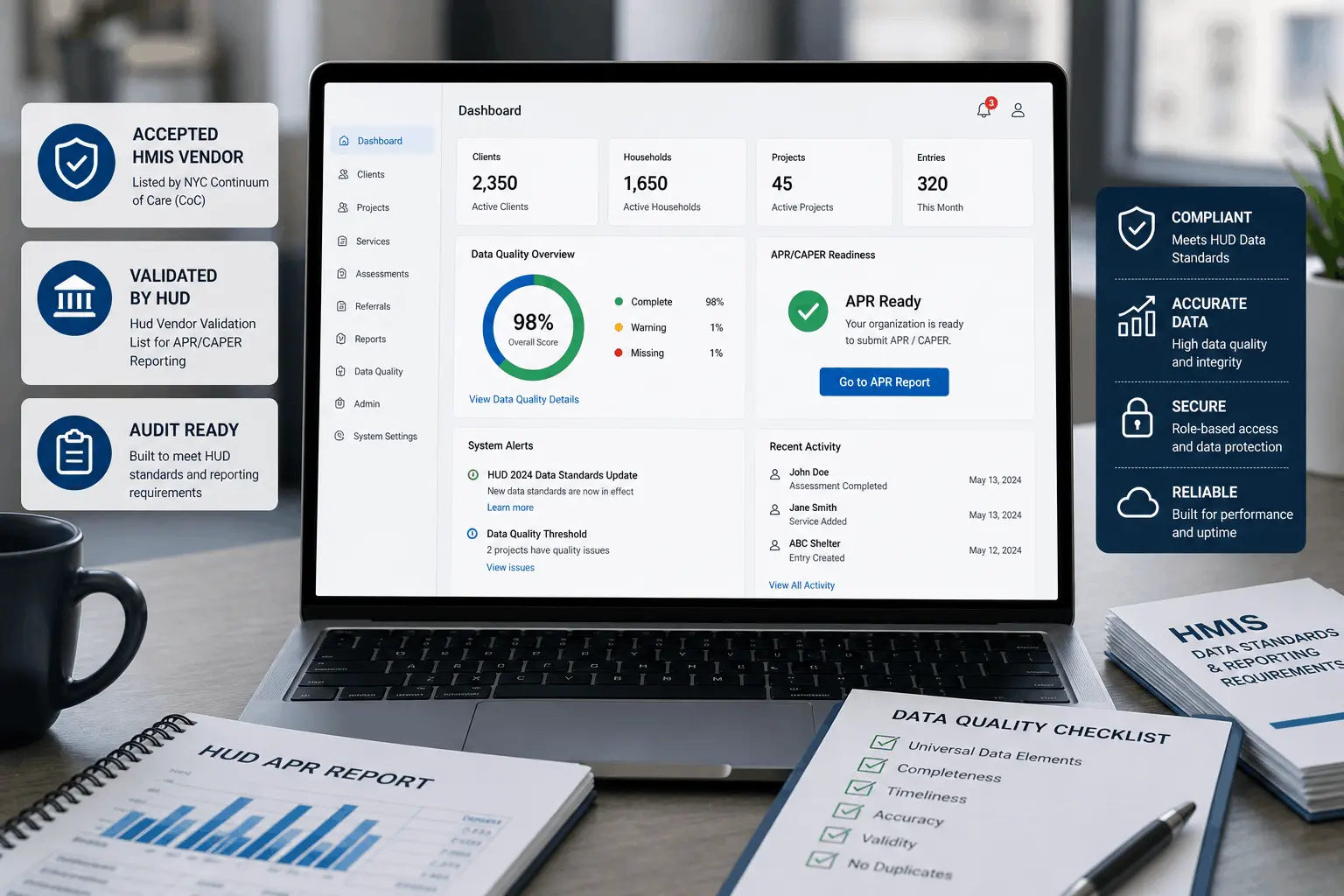
Today, we're proud to announce that PlanStreet has been recognized by both the NYC Continuum of Care and HUD (U.S. Department of Housing and Urban Development) as a compliant and validated software vendor.
In this article, we'll discuss the dangers of using outdated HMIS systems, and how PlanStreet prevents reporting errors in HUD's APR or CAPER reports that can lead to delays, audits, or even loss of funding.
What Happens When Your HMIS System Fails?
When your HMIS system fails, there are usually three levels of consequences: operations, compliance, then funding. At best, your agency can figure out a manual workaround until the issue is handled. At worst, user access can be suspended or revoked for noncompliance, and ongoing poor HMIS data quality can contribute to loss of federal or state funding.
Here's how an HMIS system failure affects different organizations:
- CoCs: May no longer have a complete picture of homelessness in the community, which weakens planning, system performance measurement, and HUD reporting.
- Nonprofits: Often causes missed documentation, delayed services, and possible sanctions if policies or security rules are violated. May have to undergo a corrective action plan.
- Government agencies: Creates reporting gaps, undermines data integrity, and triggers extra oversight, which leads to delayed grant reporting, weaker program oversight, and increased security risk.
Don't risk your agency's reputation on a noncompliant software that doesn't properly protect or store your clients' sensitive data.
What Does an HMIS-Compliant Solution Mean?
An HMIS-compliant solution must meet every data standard required by HUD. PlanStreet's HMIS software underwent robust development to ensure it met those requirements and more. New York's requirements are even stricter, with an additional NYC HMIS Data Warehouse that requires providers to upload data monthly. This means that compliant systems need to have seamless data analytics for regular data sharing.
Some of the most difficult HUD standards to achieve in practice include:
- Universal data elements: They must be collected consistently for nearly every client and project, and missing values quickly affect reporting quality.
- Project-specific data elements: Different program types have different required fields and visibility rules, so one workflow rarely fits all.
- Data quality standards: HUD expects completeness, timeliness, accuracy, and valid values across the system, which is difficult when staff are busy or use workarounds.
- Privacy and security requirements: HMIS handles sensitive client information. Communities must enforce permissions, sharing rules, and secure processes across multiple providers.
- Data sharing and participation rules: HMIS is a community system, not a single agency database, so getting every partner to enter data the same way is often challenging.
Agencies need a trusted system that can easily support data use within other platforms, allowing everyone to work together through NYC HMIS Data Warehouses and other avenues of data sharing.
Compliance Mastered: PlanStreet's Certified Vendor Status
The fact that PlanStreet is listed on both the NYC CoC HMIS vendor page as an accepted HMIS-compliant solution and the HUD Vendor Validation list for APR/CAPER reporting accuracy speaks to a higher quality of product.
This proves PlanStreet has a:
- Proven ability to meet HUD data standards
- Successful validation of complex federal reporting requirements
- Recognition by government authorities responsible for oversight
The Importance of HUD-Compliant Software Systems
If you're managing homelessness programs, workforce development, public health initiatives, or social services, you know that compliance is mission critical.
HUD-compliant software systems are the backbone for counting, coordinating, and reporting homelessness services in a way HUD recognizes and can use.
Without it, programs lose a shared system for client-level data, coordination across agencies, and the reporting needed for funding and oversight. Even with a HUD-compliant software, agencies can still struggle with legacy systems that contribute to:
- Manual reporting processes: Older setups don't exchange data well between systems, so staff must export reports and resubmit files by hand.
- Data inconsistencies: Data can often be entered in multiple places, creating conflicting values that old systems may not catch.
- Audit stress: Staff often have to reconstruct issues from reports, client charts, and old entries, which turns audit prep into time-consuming cleanup.
And when reporting fails, agencies suffer consequences such as funding delays, increased scrutiny, and operational disruption.
PlanStreet: 4 Key Features for Compliance and Case Management
Keeping all of your digital tools under a single software solution both improves reporting and time management. Workers spend about 4 hours each week (about 9% of their time) reorienting themselves after moving through software platforms.
While there may be multiple HMIS-compliant solutions, you don't just want to be compliant — you want features to help you best serve your clients. PlanStreet offers both.
1. Automated HUD Reporting
Generating a report should be one of the easiest parts of your day. PlanStreet offers both standardized HUD reports and customizable reporting features to allow your team to meet the needs of each stakeholder in your CoC.
PlanStreet simplifies reporting workflows by:
- Automating APR and CAPER report generation
- Reducing manual data entry errors through automated form completion
- Ensuring data consistency across programs
- Customizable interfaces allow reports to track specific and measurable goals
With PlanStreet, you can create reporting that works within your organization, not the other way around.
2. End-to-End Intake & Case Management
Every step of the case management process must be tracked and managed; if not, clients slip through the cracks. PlanStreet gives you the tools you need to make the administration of each step effortless. From the first contact form to celebrating program completion, PlanStreet offers tools to support client growth, including:
- Digital intake forms: Clients can submit forms via the client portal, and that information is stored for all future form needs, minimizing data errors.
- Needs assessments: Powerful form builders allow case managers to collect additional information they know they need to create the best case plan.
- Service tracking: Closed-loop referral and attendance tracking tools help case managers know when to follow up with clients before it becomes a real issue.
- Outcome measurement: Data analytics tools can apply the metrics required by HUD and stakeholders to assess success of programs and adjust quickly to course correct.
PlanStreet's HMIS intake creates a fuller case file, connecting assessments, service plans, tasks, follow-up, and documentation in one workflow.
3. Seamless Data Integration
PlanStreet supports compliance with a seamless import/export capability with other systems. That means whether you're importing data from your previous HMIS system or need to share information with another community organization, you don't have to worry about losing any data. You're given centralized, real-time data visibility that aligns with HUD requirements.
4. Security and Government-Grade Compliance
PlanStreet goes beyond HUD security requirements to ensure that your client's data is secure and safe from digital predators. Our system meets multiple standards for government-grade compliance, including:
- FedRAMP readiness: The authoritative, recognized approach for security by the US government, and requires a strict process for approval, including a third-party assessment.
- NIST 800-53 standards: A cybersecurity framework from the National Institute of Standards and Technology (NIST) on how to manage information systems safely.
- HIPAA-compliant: Ensures that only the relevant case managers and administrative staff see PHI (protected health information).
- Advanced encryption and data protection: PlanStreet's trust center breaks down our case management software's additional compliance features.
This ensures your data is compliant, secure, and audit-ready at a moment's notice.
What Makes PlanStreet Different?
PlanStreet appears alongside other HMIS vendors on official HUD listings. But we don't wait for the government or other entities to improve our quality of service. We are constantly adding new features to ensure that your organization always has room to grow.
But here's what sets us apart:
| Traditional HMIS Systems | PlanStreet |
|---|---|
| Legacy workflows | Modern, automated workflows |
| Manual reporting | Automated HUD reporting |
| Limited integrations | Open, flexible integrations |
| Slow implementation | Rapid deployment |
| Stagnant solution | Constantly improving |
Verified by Authorities. Trusted by Organizations.
At PlanStreet, we are proud to go above and beyond for our clients.
PlanStreet in Action: WHEDco
WHEDco is a Bronx-based nonprofit who helps create and maintain affordable housing, and offers programs for families and young people. They were struggling with fragmented records, case notes, and program attendance, with limited analytics to track impact and compliance.
They implemented PlanStreet to:
- Centralize client records
- Integrate program management
- Automate reporting
- Build custom workflows across case management needs
After using PlanStreet for a few weeks, WHEDco improved their data accuracy and accessibility, tracked children and teen program milestones effectively, and helped case managers save hours every week with automated recordkeeping and reminders.
PlanStreet Offers a Better Way to Manage Programs and Stay Compliant
If everyone at your agency is on the brink of burnout due to spreadsheet-based tracking, disconnected systems, and inaccurate reporting, PlanStreet is here to help. Our software provides a single, unified impact management platform to manage cases, track outcomes, remain HUD-compliant, and simplify reporting while reducing administrative burden.
Government entities such as NYC CoC and HUD's recognition of our system shows that PlanStreet is built for real-world environments and needs. Nothing is more important to us than your organization's compliance, so that you can focus on caring for your community.
Ready to See PlanStreet in Action?
If your organization is:
- Preparing for HUD reporting
- Evaluating HMIS vendors
- Struggling with compliance workflows
Then it's time to move to a system that's already proven. Explore PlanStreet's HMIS solution today or schedule a demo with our team.