Key Takeaways:
- Starting reentry planning at intake, with connected records and consistent documentation, helps keep treatment from stalling after release.
- Medicaid reentry coverage varies by state, so organizations must separate billable services from other program activities and document thoroughly.
- PlanStreet’s StreetRCM ties case management to billing workflows, giving teams clearer visibility into claims and reimbursement.
Returning to the community after incarceration is an overwhelming process. Recently released individuals may need help with substance abuse treatment, behavioral health care, housing assistance, or other important community services. Yet, access to these services remains a struggle. For example, a 2024 NIH-supported study found that only 43.8% of jails offered medication for opioid use disorder.
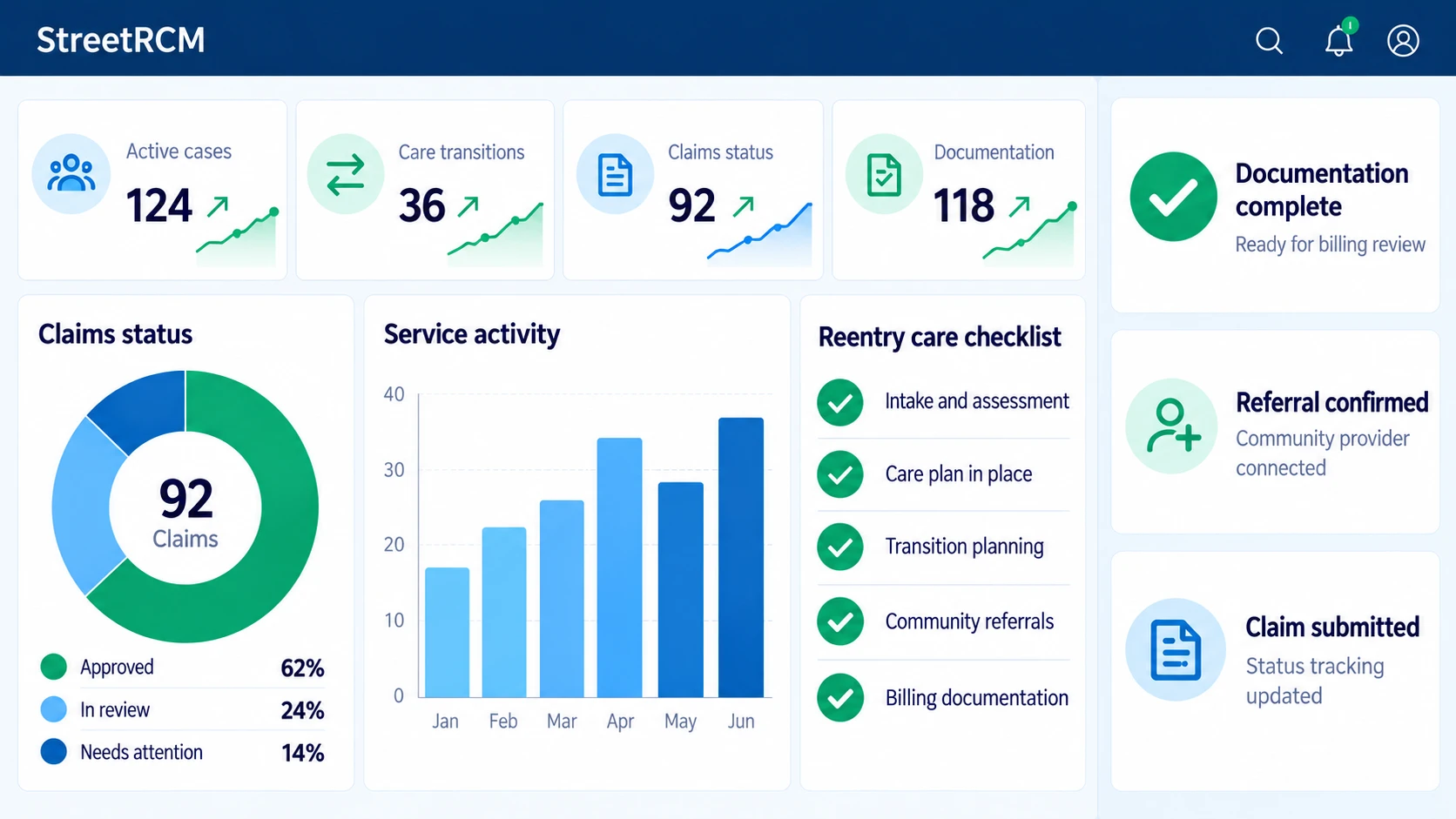
To help previously incarcerated individuals succeed once released, organizations need clear care plans, consistent documentation, and coordination across facilities and treatment providers. People both providing the service and billing for the service need to be able to quickly distinguish how to sort billable services from other essential program activities.
PlanStreet’s revenue cycle management module, StreetRCM, brings these workflows together. It connects reentry services to service documentation, supporting billing and reimbursement for Medicaid and other payer-covered services.
Common Challenges Between Treatment and Reentry Coordination
The transition from incarceration to community care requires many organizations to act on shared information. It can get difficult when they don’t have a tried-and-true way to communicate with one another, making treatment and follow-up stall.
Common challenges include:
- Unpredictable release dates that leave little time to arrange community services.
- Incomplete handoffs between correctional staff, treatment providers, and community case managers.
- Disconnected referrals without confirmation that individuals received services.
- Coverage and billing processes that require coordination across correctional facilities, Medicaid agencies, and providers.
There can be serious consequences of interrupted treatment. An NIH-supported study of 7 jails in Massachusetts found that 60.2% of inmates who received medication in jail initiated treatment within 30 days of release, compared to 17.6% of those who did not. These findings highlight the importance of connecting treatment during incarceration with accessible care after release.
Supporting the Journey From Intake to Community Care
Consider starting reentry planning at intake, not just before release. People admitted in local jails spend an average of only 31 days in custody. That is a limited window for assessing needs, coordinating treatment, and arranging community support.
Build a Connected Record From the First Assessment
Using a tool like PlanStreet allows you to create connected client records from the first intake assessment. You can continue to build on it through treatment planning, release, and follow-up. With reentry case management software, teams can:
- Capture intake information, assessments, identified needs, and individualized care plans.
- Record substance use and behavioral health needs alongside housing, transportation, and other support needs.
- Assign responsibilities, establish follow-up tasks, and update plans as circumstances change.
- Configure workflows for jail-based treatment, alternative sentencing, DWI/DUI treatment, women’s recovery programs, and community reentry.
The main benefit of this is continuity. Staff can see what needs have been identified, what has been addressed, and what requires action without asking for basic information history at each transition.
Document Services and Coordinate the Transition
Consistent documentation helps teams connect daily service delivery with the next stage of care. Pre-release case management works as a bridge to community services and requires a warm hand-off when case managers change. That means they need a robust software platform that can:
- Document counseling, case management, and peer support services.
- Track appointments, referrals, assigned responsibilities, and follow-up activities.
- Collect forms and signatures from clients, staff, and external providers.
- Maintain release plans identifying community providers and outstanding needs.
- Monitor engagement, program completion, and outcomes.
A hand-off workflow using software like PlanStreet could look like this: Assessment identifies treatment and transportation needs → staff document services and referrals → the release plan assigns follow-up responsibilities → community engagement is tracked after release.
Connect Service Documentation to StreetRCM
Complete documentation matters. In FY 2025, 77.17% of estimated Medicaid improper payments resulted from insufficient documentation. This program-wide measure includes eligibility and administrative issues—not just clinical records—and is not a claims-denial rate or necessarily evidence of fraud.
Documenting a service and establishing its eligibility for reimbursement are related but separate critical tasks. To help avoid improper Medicaid payments, StreetRCM integrates directly with PlanStreet’s case management system. It connects service documentation with billing workflows needed for reentry case management, from eligibility verification through payment reconciliation:
- Eligibility and authorization tracking: Maintain coverage information and monitor applicable service authorizations.
- Service coding and unit tracking: Associate billable activities with service codes, modifiers, and payer-specific unit rules.
- Documentation review: Review service records and supporting documentation before releasing charges for billing.
- Claims processing: Prepare and submit claims through configured payer or clearinghouse connections.
- Payment and denial management: Track claim status, process remittances, and manage corrections and follow-up.
StreetRCM provides claim-status tracking, accounts receivable aging reports, denial analytics, and reimbursement trends. Together, these views help organizations identify outstanding billing work and understand where claims or payments need attention. All reports can be created through configured exports or interfaces to support a defined data handoff for organizations using an outside billing company.
Adapt to State-Specific Reentry Requirements
Medicaid reentry demonstrations do not provide blanket coverage for every service delivered in a correctional setting. Eligibility depends on Medicaid eligibility, qualifying facility types, expected release dates, and the state’s approved demonstration terms. States may also apply age or qualifying health-condition requirements. Organizations must distinguish pre-release benefits from services covered after release.
CMS’s September 2026 guidance outlines several important boundaries:
- Coverage windows: For future approvals, CMS describes up to 60 days of pre-release coverage in adult facilities and up to 90 days in youth correctional facilities. This does not mean every existing approval has already changed; organizations should check their state’s approved terms.
- Minimum benefits: The demonstration package includes case management, clinically appropriate medication-assisted treatment for substance use disorders, and a clinically appropriate 30-day supply of prescribed medications provided at release. States may cover additional services.
- Separate youth requirements: Federal law also requires specified pre-release and post-release services for eligible incarcerated youth. Section 1115 demonstrations are not the only coverage pathway.
How PlanStreet Helps Organizations Adapt
PlanStreet’s configurable workflows help organizations structure records and billing processes around their applicable requirements. Teams can distinguish:
- Pre-release services from post-release community care.
- Covered services from nonbillable program activities.
- Medicaid-funded services from grant-funded activities and other responsibilities.
- Required documentation, authorization checks, and review steps.
These distinctions help keep a comprehensive care plan separate from the narrower set of activities eligible for reimbursement. Software supports the workflow; it does not establish coverage, replace payer requirements, or make every documented service billable. Coverage decisions must follow the applicable state program, provider, facility, and payer rules.
PlanStreet can work with organizations that utilize Medicaid funding. If you have a county or state-level reentry program, we can help you connect justice-involved treatment to Medicaid workflows.
Simplify Coordination Between Care and Billing Teams With StreetRCM
Justice-involved treatment and reentry programs need a connected view of each person’s journey, from assessment and treatment to release planning and community follow-up. PlanStreet and StreetRCM connect case management with revenue cycle workflows, helping reduce duplicate data entry and giving organizations greater visibility into claims, payments, and unresolved billing work.
Give your agency a clearer path from service delivery to billing follow-through. With PlanStreet, your staff can spend less time navigating disconnected processes and more time supporting the transition to community care. See how our StreetRCM would benefit your organization with a personalized demo. Bring your intake processes, release-planning needs, and payer requirements to learn how the platform could improve and maximize your workflows.
Frequently Asked Questions
Start with a readiness review of your state’s coverage rules, participating facilities, provider enrollment requirements, covered services, and documentation standards. A state’s reentry demonstration approval does not automatically make every agency, participant, or service eligible for reimbursement. Confirm which requirements apply to your program before configuring billing workflows.
Then define who owns eligibility verification, authorization tracking, documentation review, claims submission, and denial follow-up. StreetRCM supports these revenue cycle functions and offers credentialing support, but implementation should begin with a clear understanding of your agency’s approved services and payer relationships.
Treat release as a coverage and workflow checkpoint. Review the applicable coverage authority, service dates, eligibility information, authorizations, and receiving provider responsibilities. Pre-release demonstration benefits and post-release community services may operate under different requirements.
Using the connected-record workflows described above, your agency can maintain continuity in the care plan while establishing separate review steps for billing. StreetRCM’s eligibility verification, authorization management, and claims tracking functions support that financial workflow; the applicable state and payer rules determine what can be billed.
Start with reporting that makes unresolved work visible:
- Claim status to identify submissions awaiting action.
- Accounts receivable aging to monitor outstanding balances.
- Denial analytics to investigate recurring problems.
- Reimbursement trends to understand payment patterns.
For decision-making, review these measures alongside service volume and documentation completion.