Key Takeaways:
- PlanStreet's community-based care platform goes beyond traditional case management by integrating community connection.
- The industry is moving toward these platforms because fragmented systems cause lost referrals, duplicate work, and delayed care.
- PlanStreet solves these gaps with closed-loop referrals, integrated Medicaid billing, and predictive analytics.
Health service providers are relying more and more on CBOs (community-based organizations) and community resources to address social needs. With individuals requiring multiple programs and services to become housed, receive healthcare, or get their daily needs met, social workers need to look to more robust technology to coordinate services, staff, referrals, billing, data, and outcomes across the wider community-care continuum.
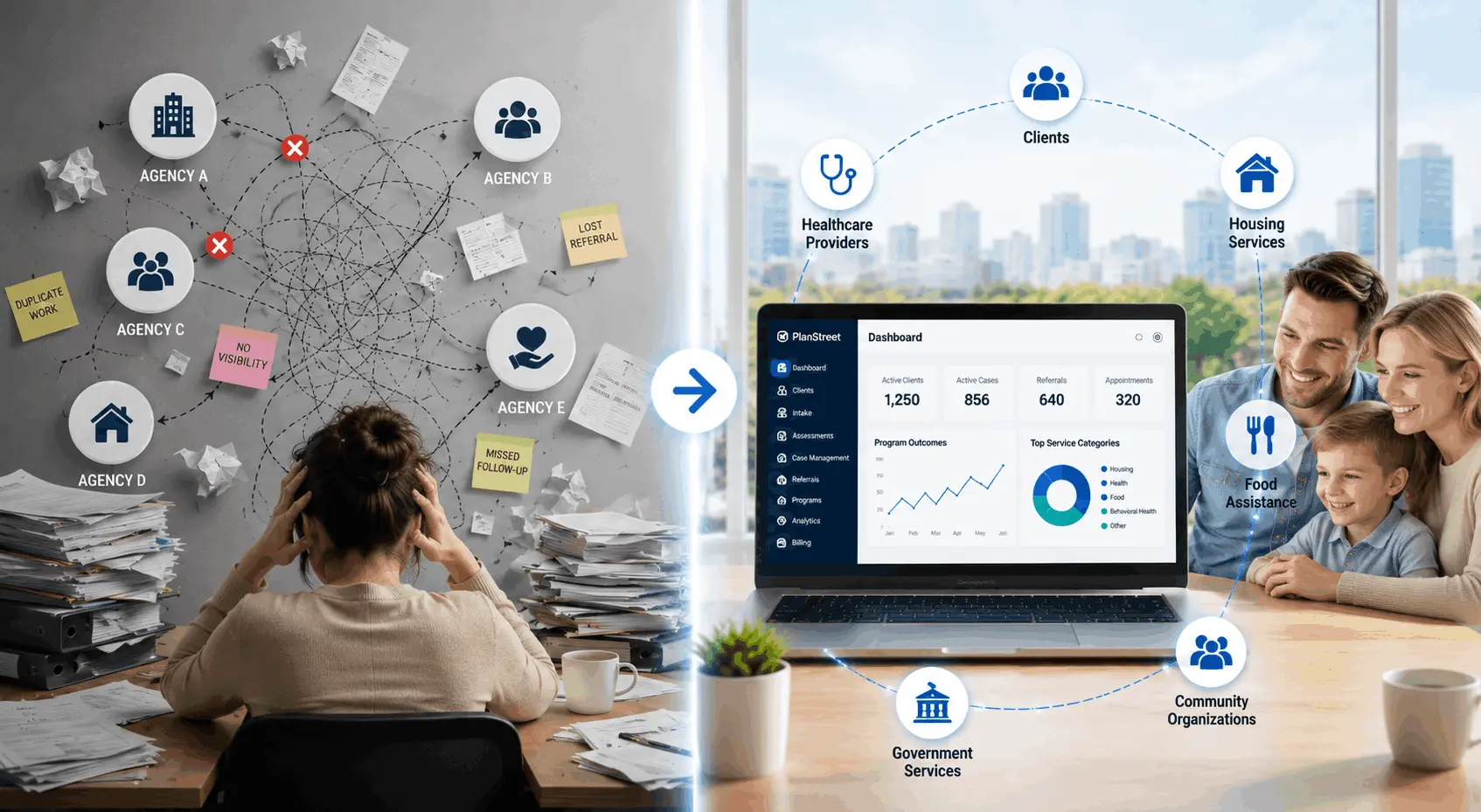
Our community-based care platform extends beyond traditional case management. It allows social workers and other providers to work together easily, supporting integrated services delivery, cross-program collaboration, and measurable outcomes.
What Is Community Care Software and Why Do Providers Need It?
Community care software is a digital platform that helps nonprofits, government, and public sector organizations better address the needs of each client. It often houses technology required for each part of the case management process, ensuring that all critical information is stored in one place.
PlanStreet's community-based care platform includes features such as:
- Streamlined intake: A single intake process that captures client information once and routes it into the right services or programs.
- Built-in assessments: Standardized screening tools that help organizations identify needs, eligibility, risks, and service priorities.
- Care and case management: Tools that let teams create, coordinate, and monitor care plans, tasks, notes, and follow-up across the service journey.
- Closed-loop referrals: Referral workflows that track whether a client was connected to a resource and whether the service was actually completed.
- Dashboards and analytics: Reporting tools that show outcomes, trends, program performance, and service gaps so teams can make data-informed decisions.
- ePrescribing: Authorized prescribers can prescribe medications directly within the platform.
- StreetRCM: Comprehensive revenue cycle management that connects clinical documentation, claims management, billing, and financial reporting.
- MilesAI: An AI tool to streamline case notes, summaries, claims validation, payments, reporting and analytics, and more.
Why Is the Industry Moving Toward Community-Based Care Platforms?
Up to 60% of a person's health is defined not by their genetic health, but by their zip code. Social and built environments are just as important to a complete sense of health. A focus on getting the right services for clients within their own neighborhoods requires a platform that can handle better coordination across fragmented provider and community networks.
Additionally, community-based care models are growing in popularity, including the Home and Community-Based Services Program, which serves 2.5 million people with disabilities in the US. Generally, people with disabilities prefer to receive support from within their community rather than in an institutional setting, leading to a surge in need for community-based care platforms.
The Difference Between Case Management and Community-Based Care
The main difference between case management and community-based care is that case management is about managing the client's journey, while community-based care is about plugging into the network of organizations that deliver the journey.
In practice, a case manager is typically one role inside of a community-based system. When you use a human services platform, this allows everyone within the system to interact with one another better.
Here's an example of how the two play out differently in a real scenario. If a person needs housing, food support, and behavioral health care, a case manager may connect them to those resources, follow up, and track progress. Community-based care is the broader network that makes those services available locally and coordinates them across agencies.
And a community-based care platform, like PlanStreet, allows providers to work together in one platform to track closed-loop referrals, assess programs, and improve health outcomes.
What Problems Does a Community-Based Care Platform Solve?
Community-based care platforms solve many of the same issues as case management software, but at a larger scale. They're designed to help multiple agencies in a community with every part of their administrative process, allowing CBOs and other nonprofits to focus more on integrated service delivery.
1. Manual Referral Tracking
On average, about 54% of referrals end in a completed appointment. Manual referral tracking contributes to this low number, with providers not always catching if a client has followed through, or simply not having the time to check.
Closed-loop referral tracking helps providers stay on top of clients' needs through:
- Real-time visibility: Providers can see the status of a referral at each stage.
- Simple follow-ups: Providers can follow up through secure messaging with their client or the referred provider to get a quick answer without waiting for a phone call.
- Automated alerts: Providers can receive text, email, or in-platform notifications if a referral has not been completed, prompting them to reach out to address the issue.
These solutions help providers ensure that their clients actually receive the care they need.
2. Fragmented Data Across Agencies
When a social worker doesn't have access to critical information from different providers, the system breaks down.
Let's say a client is referred from a behavioral health provider to a housing nonprofit. However, they use different systems, so they have different versions of the client's contact info, needs assessment, and service history.
The housing team may not see that the client already completed an intake, while the behavioral health team may not know whether the referral was accepted, which leads to duplicate paperwork, delayed services, and gaps in follow-up.
This can prevent a person from receiving the care they need in a timely manner, which can be life-threatening, particularly for unhoused individuals.
3. Limited Outcome Visibility
When working within a community, social workers need to know which of the services they are referring clients to are delivering results. That's why they need a robust community care management software that has robust analytics reporting.
These tools help organizations:
- Monitor progress
- Evaluate impact
- Make data-driven decisions
PlanStreet's Miles AI offers a conversational feature to ask questions naturally and get the answers you need from your reports. The predictive analytics can forecast demand and help your team identify risks before they get in the way of your client receiving services.
4. Cumbersome Workflows and Duplicate Work
Nonprofits and CBOs are working within tight budgets, so it can feel incredibly frustrating to work within an outdated workflow. If you're still saving different versions of spreadsheets, it's time to look to a community-based care platform for a better solution.
For example, the Dane County Sheriff's Department implemented PlanStreet with an automated scheduled synchronization of Spillman Flex so they could easily see updated participant records and custody timelines in one dashboard. It's automatically updated every hour, helping case managers prioritize case planning, housing, and transportation for individuals with imminent release.
5. Erroneous Billing
Approximately 47% of improper payment rates in Medicaid are overpayments due to manual errors. Switching to integrated Medicaid billing software helps your administrative teams bill correctly the first time.
Features in PlanStreet's Street RCM cover every step of the Medicaid billing process, including:
- Billing requirements: Stay aligned with payer rules from the start.
- Claims processing: Turn services into clean claims faster.
- Managed care reimbursements: Keep managed care billing moving and payments on track.
- Compliance audits: Be audit-ready with every claim and record.
- Prior authorizations: Track approvals before services are delivered.
- Denial management: Catch, fix, and resubmit denials.
Learn More About PlanStreet's Community-Based Care Platform
Community-based care platforms are becoming the operational backbone of how services get delivered across a fragmented network of providers. As referral tracking, data sharing, outcome reporting, and billing all move into a single connected system, agencies can spend less time chasing paperwork and more time serving their communities.
PlanStreet was built to help CBOs, human services agencies, and public sector organizations do exactly that. From closed-loop referrals and integrated Medicaid billing to Miles AI's predictive analytics, PlanStreet gives your team the tools to coordinate care, reduce administrative burden, and show measurable outcomes across every program you run.
If you're ready to see how a community-based care platform can work for your organization, schedule a demo with PlanStreet today.
Frequently Asked Questions
PlanStreet is a care coordination software built to integrate with existing systems rather than replace an agency's entire tech stack. Through API connections and scheduled data synchronization, like the Spillman Flex integration used by the Dane County Sheriff's Department, agencies can keep data current across platforms without manual re-entry, which matters most for organizations managing multiple funding streams and reporting requirements.
Yes. Street RCM manages the Medicaid billing lifecycle, including prior authorizations, claims processing, and denial management, while PlanStreet's broader case management and analytics tools track outcomes for grant-funded and other non-billable programs. This lets finance and program teams pull from the same client record instead of maintaining separate systems for compliance and impact reporting.
Miles AI allows teams to query reporting data conversationally and surfaces predictive insights that help leaders forecast service demand and flag client risk factors before they escalate. For care-management and MCO leaders, this shifts planning from reactive to proactive, supporting better staffing and resource allocation decisions.
PlanStreet's streamlined intake captures client information once and routes it into the appropriate programs, while standardized assessment tools can be configured to meet each agency's specific screening and eligibility needs. This reduces duplicate intakes across a referral network while still letting individual agencies maintain their own workflows.