Key Takeaways:
- Attendance and service counts show engagement, but they only reveal what care is helping clients achieve when read alongside clinical outcomes and goals that matter to the client.
- Programs can track progress by linking each client goal to a baseline, an indicator, and a review date, then repeating assessments and using the results in care decisions.
- PlanStreet connects assessments, treatment plans, and medication workflows with Medicaid billing through StreetRCM, giving teams one view of client progress and program reporting.
Attendance and service delivery are important parts of understanding a behavioral health program’s impact. Connecting that activity with changes in how clients feel, function, and progress toward personally meaningful goals provides deeper insights into what care is helping them achieve.
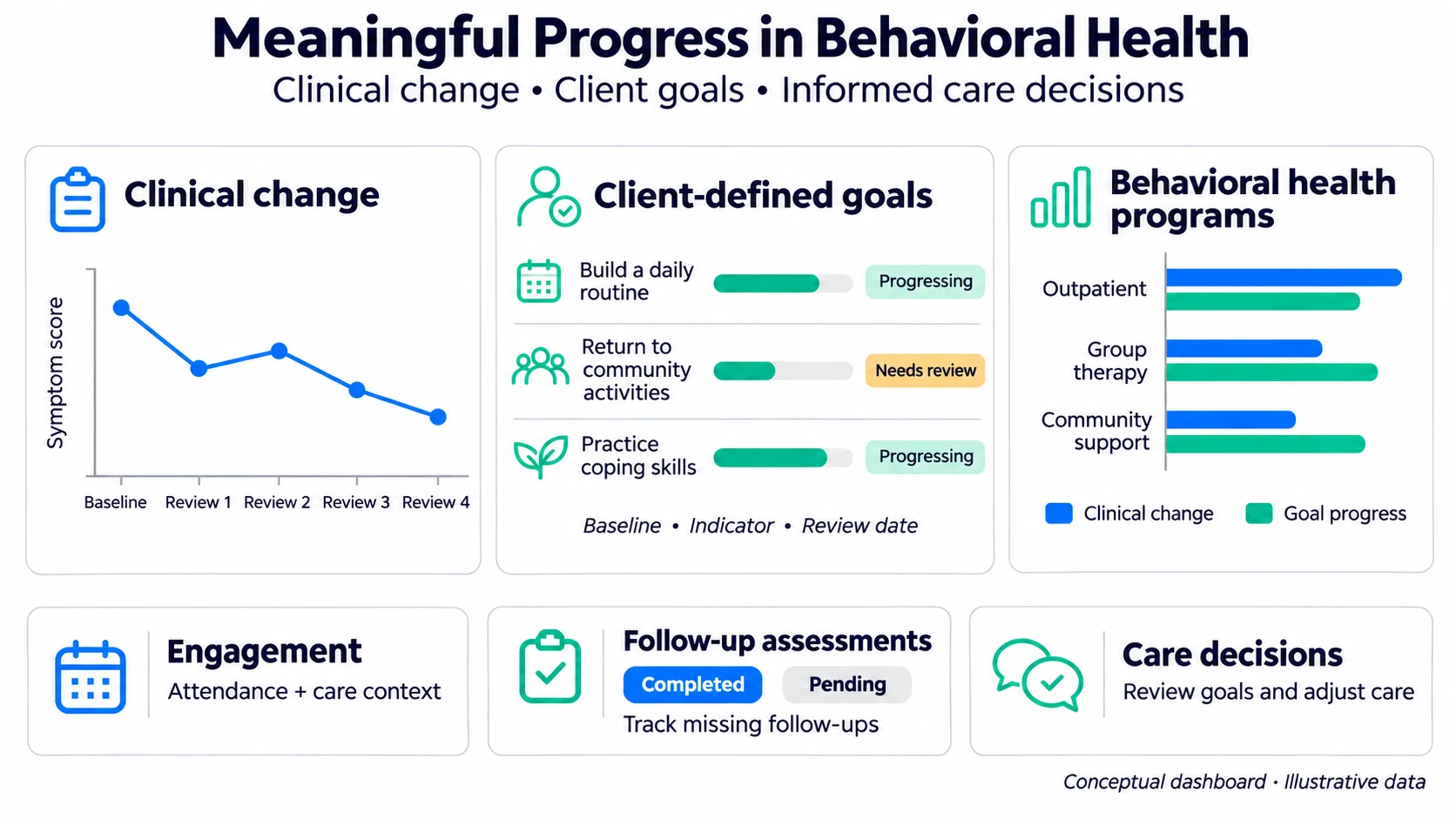
Attendance still matters as evidence of engagement, but it needs to be interpreted alongside clinical and person-centered outcomes. Behavioral health reporting is complex, with the NCQA (National Committee for Quality Assurance) examining 1,410 measures and metrics across 39 federal reporting programs in its 2021 framework.
This article outlines a practical approach to behavioral health outcomes tracking: connecting what clients want to achieve with what teams measure, how they interpret progress, and what they do next.
Why Attendance and Service Counts Cannot Tell the Whole Story
Attendance offers valuable insight into engagement. To understand how that engagement relates to progress, leaders need to connect three categories of information:
- Service activity: visits, sessions, and services delivered.
- Care processes: assessment completion, follow-up, and treatment-plan review.
- Outcomes: changes in symptoms, functioning, and progress toward client-defined goals.
These categories answer different questions. Completing an assessment documents a care process; comparing results over time helps teams evaluate change.
Yet outcomes remain underrepresented in standardized reporting. NCQA’s 2021 review identified 35 unique standardized behavioral health quality measures across federal programs, but only three were outcome measures, and one was an intermediate outcome measure.
The aim is not to replace attendance with a single clinical score. It is to interpret activity, processes, and outcomes together. This changes the reporting conversation from “How much care did we provide?” to “What changed, for whom, and what should we do next?”
Define Progress Around Clinical Change and Client Priorities
Meaningful progress has two complementary dimensions: clinical change and improvements that matter to the client. Standardized measures provide consistent information about symptoms and functioning, while individual goals establish what improvement should be possible in daily life.
The American Psychiatric Association describes measurement-based care as repeated assessment that informs treatment. Clinicians and clients review results together and use them to guide care decisions. A practical approach pairs a relevant, validated instrument with a measurable, client-defined goal.
For example, a hypothetical client might want to manage anxiety well enough to return to a weekly community activity. The team could track an appropriate anxiety measure alongside participation in that activity, using an agreed milestone and review date. Together, these perspectives keep progress monitoring grounded in clinical evidence and the client’s priorities.
How to Measure Meaningful Progress in Behavioral Health Programs
Making progress measurable starts with connecting the client’s priorities to a clear, repeatable review process. The following steps bring goals, assessment findings, and care activity together so teams can interpret change, adjust care, and build more useful program reporting.
Connect Each Goal to a Baseline and a Defined Indicator
Each client-defined goal should be actionable by documenting:
- Baseline: Where the client is starting.
- Indicator: What change the team will track.
- Measurement method: How progress will be assessed, using a suitable standardized measure where appropriate.
- Review interval: When progress will be evaluated.
- Responsible staff member: Who will collect and review the information.
Create a workflow to clarify the relationship. It should look something like this: client priority → treatment goal → baseline → indicator → review date.
Goal-attainment scaling can structure the assessment of individualized progress. Before aggregating results, establish consistent definitions, scoring methods, and review periods. This helps turn personalized goals into standardized program outcomes.
Repeat Assessments and Use Results in Care Decisions
Set a repeat-assessment schedule suited to the instrument, population, care setting, and applicable reporting requirements. Review findings with clients and document how they inform treatment decisions.
Keep assessment completion separate from clinical change. For example, NCQA’s depression measure distinguishes three indicators within a 120–240-day follow-up window:
- Follow-up measurement: A documented follow-up PHQ-9 score.
- Response: At least a 50% reduction in the PHQ-9 score from baseline.
- Remission: A PHQ-9 score below 5.
Interpret Engagement and Medication Records Alongside Outcomes
Once assessment trends are available, reviewing them alongside engagement and medication records can provide a greater understanding of the client’s experience. Each source contributes a different perspective:
- Attendance and service engagement show which services the client participated in and when.
- Progress notes add observations, client feedback, and context about barriers or changes in care.
- Prescribing records document medication orders, while administration records document what was given.
- Assessment results help teams examine how symptoms and functioning changed over the same period.
PlanStreet’s eMAR brings scheduled medication activity, administration records, missed or late activity, and connected ePrescribing workflows into the broader person record, alongside clinical notes, care plans, and services. This connected information can help teams explore what may be contributing to progress or where further discussion is needed.
Aggregate Results Without Hiding Missing Data
When moving from individual reviews to program reporting, define eligible clients, baseline requirements, follow-up windows, and outcome thresholds before calculating rates. State whether results cover all eligible clients or only those with both baseline and follow-up assessments.
A reporting panel can distinguish:
- Follow-up assessment completion.
- Symptom response or remission, using specified definitions.
- Client-goal progress.
- Engagement and care-process indicators.
When comparing programs, consider differences in client populations, baseline needs, and follow-up completeness so results can be interpreted in context.
Turn Findings Into a Quality Improvement Cycle
Build on program reporting with a recurring review process that connects findings to action. Assign clear responsibility for measurement collection, clinical review, and reporting, then use each review to:
- Identify stalled progress or gaps in follow-up.
- Review individual cases with clinicians and incorporate client perspectives.
- Test targeted workflow changes, such as adjusting assessment reminders or review procedures.
- Reassess results to understand whether those changes are helping.
Evidence supports linking measurement to clinical decisions. A meta-analysis of seven randomized trials involving 2,019 adults with depressive disorders found higher odds of remission with measurement-based care. All trials involved pharmacotherapy, and the authors noted a small evidence base, high risk of bias, and substantial differences between studies.
How PlanStreet Connects Care Documentation, Medication Workflows, and Billing
Putting this measurement approach into practice requires connected information. PlanStreet’s Community-Based Care Platform supports client progress monitoring through assessment, case-planning, service-tracking, and reporting capabilities, while eMAR, ePrescribing, and StreetRCM connect medication and billing workflows with the broader care record.
Each part contributes to the workflow:
- Assessments establish documented needs and baselines that teams can revisit over time.
- Treatment plans and service tracking translate those needs and client priorities into goals, while progress notes document services, observations, and next steps.
- eMAR and ePrescribing keep medication orders, scheduled doses, and administration records connected with clinical notes, care plans, and support services.
- StreetRCM links clinical documentation with eligibility verification, authorization management, claims submission, denial management, payment reconciliation, and financial reporting to support Medicaid billing workflows.
Together, these connections support behavioral health reporting and clinical review. Shared indicators, review periods, and reporting practices help teams turn that information into a consistent picture of client growth or decline.
Clinical and financial results provide complementary views of program performance. Billing data helps teams monitor reimbursement and operational sustainability, while clinical measures and client-defined goals show how care is supporting meaningful progress.
Make Progress Visible and Actionable With PlanStreet
Meaningful program outcome measurement connects client priorities, repeated assessments, engagement, and clinical context. Together, these perspectives help teams understand what is changing, recognize where additional support may help, and decide what to do next.
PlanStreet’s behavioral health outcomes tracking software connects assessments, treatment plans, progress notes, and medication workflows to support a fuller picture of client progress. With StreetRCM linking care documentation to Medicaid billing processes, teams can bring clinical and operational information together to support coordinated care, client progress monitoring, and program reporting.
Frequently Asked Questions
Report follow-up completion separately from improvement, with a clear denominator for each rate. If results include only clients with baseline and follow-up scores, identify that group and disclose missing assessments. NCQA’s depression measure separates follow-up documentation from response and remission, helping distinguish measurement availability from clinical results.
Use a shared structure to document each client’s priority, baseline, expected achievement, and review date. Apply consistent goal-attainment methods while preserving individual goal descriptions. Goal-attainment scaling offers a structured way to assess personalized progress, helping programs summarize achievement without losing sight of what those outcomes mean to clients.
Review both findings with the client to understand what has changed and what remains difficult. Discuss whether additional support, an adjusted treatment approach, or a revised timeline would help. Measurement-based care and person-centered goal tracking provide complementary perspectives that can guide shared decisions about the next steps in care.
Comparisons are most useful when programs share eligibility criteria, instruments, outcome definitions, and follow-up windows. Standardized specifications provide a foundation for meaningful comparisons. Include context about client populations, baseline needs, and missing follow-up data so teams can interpret differences and identify areas for further review.
Billing data adds service and operational context to clinical findings. StreetRCM connects clinical documentation with claims, billing, and financial reporting. Present these records alongside assessments and client-goal progress: billing information helps teams understand service delivery and reimbursement, while clinical and person-centered measures describe changes in clients’ lives.