Key Takeaways:
- Outreach teams work in unpredictable settings, so documentation often gets delayed and important details can be lost.
- Mobile HMIS tools let staff document encounters and referrals on the spot while keeping client privacy central.
- PlanStreet puts mobile documentation, outreach history, and service tracking in one platform so teams can focus on building relationships.
Caring for unhoused individuals doesn’t just happen behind a desk. Street outreach teams are out on foot meeting people in encampments, shelters, parks, transit, and other community settings. Teams often respond to urgent needs and build trust over time with people in desperate circumstances. And the need is great—at the last point-in-time homeless count, 266,320 people were unsheltered.
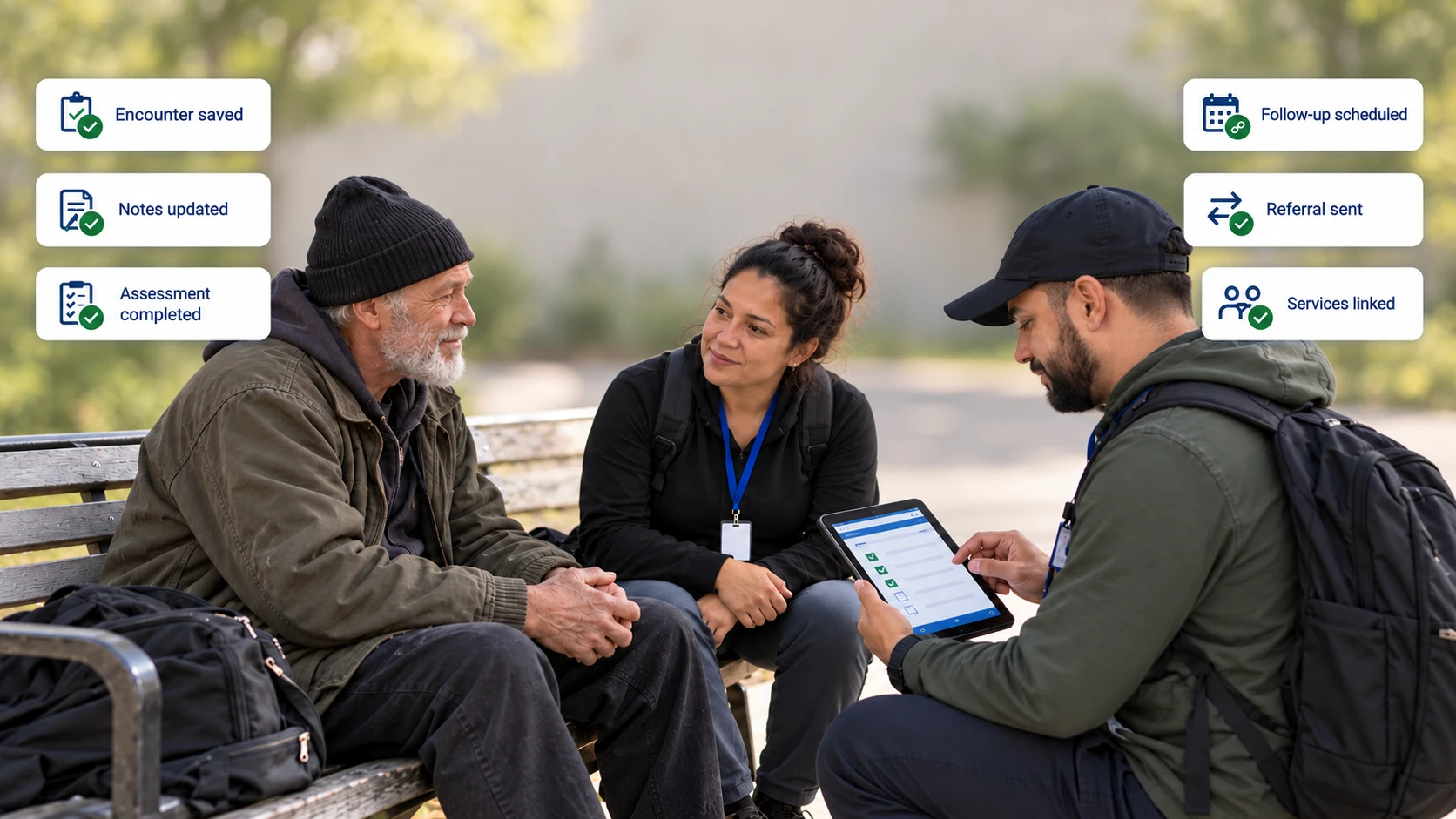
To care for people living on the streets effectively, case managers need tools to help them work on the go. Relying on paper notes, disconnected tools, or end-of-day data entry causes a delay. That can lead to important details slipping through the cracks, like a person’s location, immediate needs, or history of engagement.
Mobile HMIS software remedies this issue by bringing documentation into the field. When teams can capture outreach activity, assessments, and service connections at the point of contact, providers can strengthen homeless outreach documentation for more effective case management.
Why Field Documentation Is a Street Outreach Challenge
Street outreach teams work in unpredictable environments. Workers are often balancing urgent needs, relationship-building, safety considerations, and referrals in real time. They don’t have the opportunity to open a laptop or complete lengthy documentation before moving to the next contact.
But when they delay in documenting, it creates broader operational challenges:
- Staff may spend time re-entering information, searching for past notes, or reconstructing encounters from memory.
- Incomplete records can limit visibility into client needs, service connections, and follow-up responsibilities.
- Duplicate records or inconsistent details can complicate HMIS reporting and data-quality efforts.
- Referral and Coordinated Entry activity may be harder to track from initial outreach through housing or service connection.
- Program leaders may have less reliable information for understanding outreach coverage, staffing needs, and outcomes.
Mobile-friendly documentation gives workers a practical way to capture essential information while it is accurate, actionable, and connected to the next step in a person’s care.
4 Benefits of Mobile HMIS Use in the Field
Street outreach software should help staff document meaningful interactions while they are in the field, then carry that information forward into coordinated services, referrals, and housing workflows. The goal is not to add administrative burden during outreach; it is to make essential client information available when it is most accurate and useful.
1. Captures Outreach Encounters in Real Time
It’s critical to collect the essential details of an encounter right after it happens. This helps them build proper data for assessment of larger-scale problems. Qualitative data helps teams identify patterns, resource gaps, and disparities.
When using mobile homeless outreach documentation, teams can quickly deliver critical information at or right after the point of contact, including:
- Encounter date and time
- Location
- Engagement notes
- Client priorities
- Immediate health, food, shelter, and safety needs
- Referrals and follow-up steps
2. Builds a Longitudinal Outreach History
When working within street outreach software, each interaction builds a person-centered record that all stakeholders can access. A longitudinal history supports continuity when different outreach workers meet the same person or when that person moves among an encampment, shelter, hospital, or housing program. It also lets staff build on past conversations instead of repeatedly asking a person to retell their circumstances.
3. Support Assessments, Services, and Follow-Up
A field-ready mobile HMIS can turn documentation into a practical next action for outreach case management. Useful capabilities include:
- Mobile-friendly assessments that can be completed gradually as trust develops.
- Needs tracking and individualized service plans.
- Benefits navigation and document collection.
- Referral creation, appointment tracking, and follow-up reminders.
- Visibility into whether a referral led to connection, placement, or another outcome.
4. Implement Geolocation Thoughtfully
Geolocation is a critical tool that can help agencies understand where outreach is most effective. When used appropriately, it supports:
- Identifying areas with limited outreach coverage.
- Coordinating routes and avoiding duplicated field effort.
- Noting general service areas or encampment locations.
- Analyzing where demand for housing and supportive services is emerging
However, the most important part of using geolocation is keeping privacy central. Agencies should establish clear rules for client consent, role-based access, minimum-necessary data collection, record retention, and the appropriate level of location precision.
Federal USICH guidance recommends using mapping tools to understand outreach coverage gaps and population density while also involving outreach teams and people with lived experience in privacy-related decisions.
Connecting Outreach to Coordinated Entry
Effective street outreach does not end when a worker makes contact or completes an assessment. It can create a clear, documented path into the wider homeless-response system. It helps people move from initial engagement toward the services and housing resources that best fit their needs.
A mobile HMIS can support that transition by helping outreach staff:
- Initiate or update a client record during field engagement.
- Complete applicable assessments as information becomes available and trust develops.
- Document referrals to shelter, health care, behavioral health, benefits assistance, and housing programs.
- Track whether a referral resulted in contact, enrollment, placement, or a need for additional follow-up.
- Share appropriate information with authorized partners to reduce disconnected handoffs.
- Monitor progress from first contact through service connection and housing navigation.
Mobile HMIS helps connect street outreach to Coordinated Entry, and this process is not one-size-fits-all. Each CoC develops its own policies, prioritization approach, assessment process, and provider roles based on local resources and community needs. The right technology should support those locally designed Coordinated Entry and HMIS workflows rather than requiring outreach teams to conform to a rigid, generic process.
Implement Mobile Outreach Work With PlanStreet
PlanStreet’s Community-Based Care Platform brings documentation, case management, and service coordination to your phone. This allows case managers to work closer to the point of contact, helping teams capture key information while it is current and actionable.
PlanStreet supports mobile outreach work through capabilities such as:
- Mobile documentation: Record outreach interactions, client details, engagement notes, immediate needs, and next steps while staff are working in shelters, encampments, and other community settings.
- Outreach history: Maintain a clear, person-centered record of prior contacts, case notes, assessments, documents, referrals, and service activity.
- Geolocation: Give authorized teams greater visibility into where outreach is occurring, helping them understand service coverage and coordinate field activity.
- Assessments and service tracking: Connect identified needs to assessments, service plans, benefits navigation, referrals, follow-up tasks, and documented outcomes.
- HMIS and Coordinated Entry support: Help agencies align field documentation with broader housing and service workflows, including the processes used to assess, prioritize, refer, and connect people to resources.
By bringing these functions into one platform, PlanStreet can help outreach staff spend less time searching across disconnected records or recreating encounters from memory. Instead, teams can focus more of their time on sustained engagement, relationship-building, and timely follow-up.
How to Start Using Mobile HMIS Software at Your Agency
Implementing mobile HMIS software works best when agencies begin with real outreach workflows. Start by mapping how information currently moves from a field encounter into HMIS, then identify where staff rely on paper notes, delayed entry, duplicate records, or informal handoffs.
Use a structured rollout process:
- Identify the minimum field data set. Define what staff must capture during an encounter, such as contact details, current living situation, or immediate needs.
- Set privacy and geolocation policies. Establish consent practices, role-based permissions, data-retention requirements, and clear limits on how precise location information will be collected and used.
- Train in real-world scenarios. Practice documenting a shelter visit, encampment engagement, referral, and follow-up task from a mobile device.
- Launch with feedback loops. Give staff a clear way to report workflow barriers, missing fields, and training needs during early use.
- Measure and refine. Track encounter-to-entry time, completed contact histories, referral outcomes, follow-up completion, and staff feedback.
Make Every Outreach Contact Count With PlanStreet
Street outreach is most effective when each interaction can lead to a timely, coordinated next step. With mobile HMIS tools that support in-field documentation, outreach history, service tracking, and Coordinated Entry workflows, agencies can help teams preserve critical context and stay focused on building the relationships that make housing and service connections possible.
PlanStreet’s Community-Based Care Platform brings outreach documentation, case management, service tracking, and HMIS-connected workflows into one platform. Schedule a demo to see how PlanStreet can help your team document in the field, coordinate follow-up, and support more connected outreach operations.
Frequently Asked Questions
Street outreach software helps teams document field contacts, client needs, assessments, services, referrals, follow-up tasks, and outreach history while working outside a traditional office setting.
A mobile HMIS helps staff record information closer to the time of an encounter, reducing reliance on delayed data entry and strengthening continuity across outreach, shelters, service providers, and housing programs.
Yes. A well-designed workflow can support assessment, referral, prioritization, and placement-related activities that connect field engagement to a community’s Coordinated Entry process. HUD’s data standards include structured elements for Coordinated Entry assessments and referral-related events.
Geolocation can help agencies understand service coverage, coordinate field activity, identify engagement gaps, and plan outreach routes. Agencies should use clear privacy, consent, and access-control practices when collecting location data.
Agencies should look for mobile documentation, client history, assessments, service and referral tracking, HMIS compatibility, Coordinated Entry support, configurable workflows, reporting, role-based permissions, and privacy controls.